Modellazione a ordine ridotto
Utilizzare Deep Learning Toolbox™ per le attività della modellazione a ordine ridotto.
La modellazione a ordine ridotto è una tecnica che consente di ridurre la complessità computazionale o i requisiti di memoria di un modello, preservandone al contempo la fedeltà entro un intervallo di errore accettabile. L'utilizzo di un modello a ordine ridotto può semplificare la progettazione e l'analisi del controllo. Ad esempio, è possibile sostituire i sottosistemi impegnativi dal punto di vista computazionale in un modello di Simulink® con una rete neurale addestrata in grado di produrre previsioni realistiche.
È possibile creare modelli a ordine ridotto (ROM) dei sottosistemi modellati in Simulink, inclusi modelli di simulazione a ordine completo, ad alta fedeltà e di terze parti. È inoltre possibile creare ROM utilizzando dati esistenti nel dominio del tempo.
L'app Reduced Order Modeler fornisce un workflow nell'interfaccia utente per la creazione dei ROM. Per utilizzare l'app, installare il pacchetto di supporto Reduced Order Modeler for MATLAB® seguendo le istruzioni riportate in Acquisizione e gestione dei componenti complementari.
App
| Reduced Order Modeler | Create reduced order models based on Simulink models, subsystems within models, or simulation data (Da R2025b) |
Funzioni
exportNetworkToSimulink | Generate Simulink model that contains deep learning layer blocks and subsystems that correspond to deep learning layer objects (Da R2024b) |
Blocchi
| Predict | Predict responses using a trained deep learning neural network |
| Stateful Predict | Predict responses using a trained recurrent neural network |
Argomenti
- Reduced Order Model of a Jet Engine Turbine Blade (System Identification Toolbox)
Create a ROM of a jet engine turbine blade, using the long short-term memory (LSTM) and NSS model types.
- Physical System Modeling Using LSTM Network in Simulink
This example shows how to create a reduced order model (ROM) that acts as a virtual sensor in a Simulink® model using a long short-term memory (LSTM) neural network.
- Reduced Order Modeling Using Continuous-Time Echo State Network
This example shows how to train a continuous-time echo state network (CTESN) model to solve Robertson's equation.
- Generate Deep Learning SI Engine Model (Powertrain Blockset)
Generate a deep learning SI engine model from measured transient engine data.
- Implement Unsupported Deep Learning Layer Blocks
Learn how to implement unsupported deep learning layer blocks.
Informazioni complementari
- Modellazione a ordine ridotto (Simulink)
- Modellazione di ordine ridotto (System Identification Toolbox)
- Reduced Order Modeling with MATLAB and Simulink
Esempi in primo piano
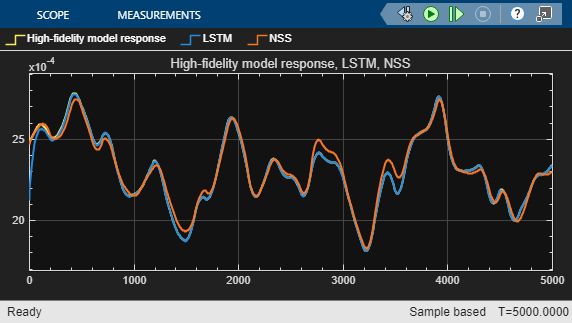
Reduced Order Model of a Jet Engine Turbine Blade
Create a ROM of a jet engine turbine blade, using the long short-term memory (LSTM) and NSS model types.

Reduced Order Modeling of Electric Vehicle Battery System Using Neural State-Space Model
A reduced order modeling (ROM) workflow, where you use deep learning to obtain a low-order nonlinear state-space model that serves as a surrogate for a high-fidelity battery model. The low-order model takes the current (charge or discharge) and state of charge (SOC) as inputs and predicts voltage and temperature of an electric vehicle (EV) battery module while the battery is being cooled by an edge-cooled plate with a coolant at a constant flow rate. You train the low-order model and deploy it in Simulink® to compare it against the high-fidelity model.

