Pipe Flow with Entrained Water Droplets
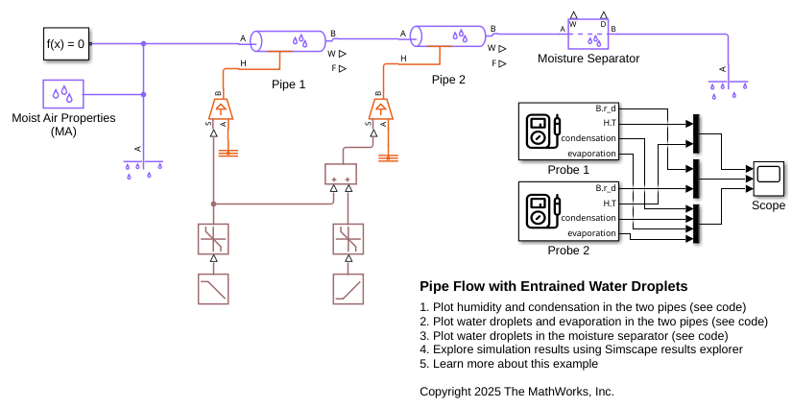
R2026bThis example shows how to model water droplets entrained in a moist air flow. The model consists of a series of two Pipe (MA) blocks with decreasing wall temperature gradient, which results in condensation.
Physically, when water vapor condenses in moist air, airflow can entrain condensate as suspended liquid droplets or solid crystals. Entrained water can appear as fog.
To model entrained water droplets:
Select Enable entrained water droplets parameter in the Moist Air Properties (MA) block.
Specify the percentage of the condensation that remains in the moist air flow in the Fraction of condensate entrained as water droplets parameter.
Moist air domain blocks follow several assumptions in modeling entrained water droplets:
Droplets are small aerosol particles of negligible volume.
Droplets do not affect the specific volume or density of the moist air flow.
Droplets do not affect moist air transport properties such as dynamic viscosity and thermal conductivity.
Droplets contribute to enthalpy and thermal mass, and therefore the temperature, of the moist air flow.
Droplets evaporate into the moist air flow if relative humidity decreases below the saturation point.
The moist air flow absorbs the latent heat of evaporation, which lowers the air temperature.
In this model,
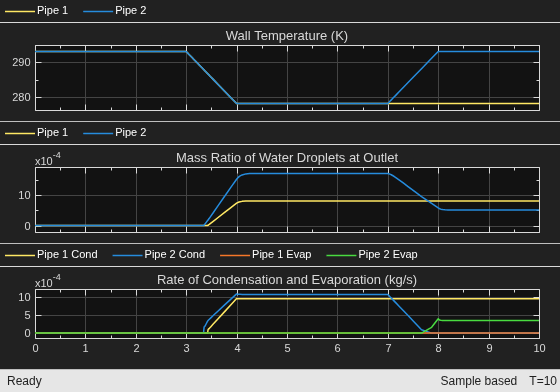
The pipe wall temperature of both pipes decreases linearly by 15 K, resulting in condensation.
100% of the condensate remains in the flow as water droplets.
The wall temperature of
Pipe 2rises by 15 K, evaporationg some condensate into vapor.The latent heat transferred from the airflow to the water suppresses the temperature increase compared to a case without water droplets.
The Moisture Separator (MA) block removes remaining water droplets from the moist air flow.
Open the Model
Simulation Results from Scopes
Simulation Results from Simscape Logging
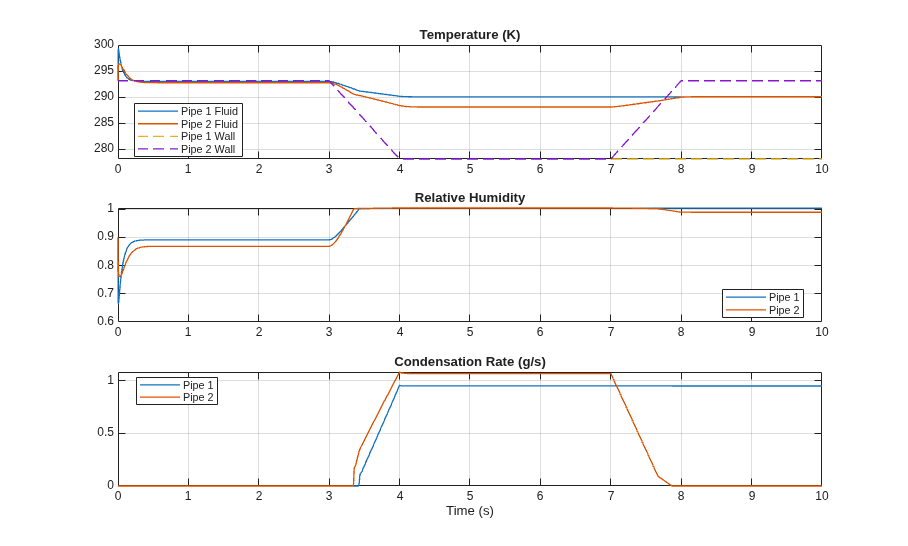
This figure shows condensation when the wall temperature drops by 15 K at t = 3 s. As the moist air temperature drops, relative humidity increases to 100%. In the first pipe, to keep the fraction of water vapor below saturation, the water vapor condenses at 0.951 g/s. The moist air temperature of the second pipe decreases further, increasing the condensation rate to 1.06 g/s. At t = 7 s, the wall temperature of the second pipe increases by 15 K and condensation stops.
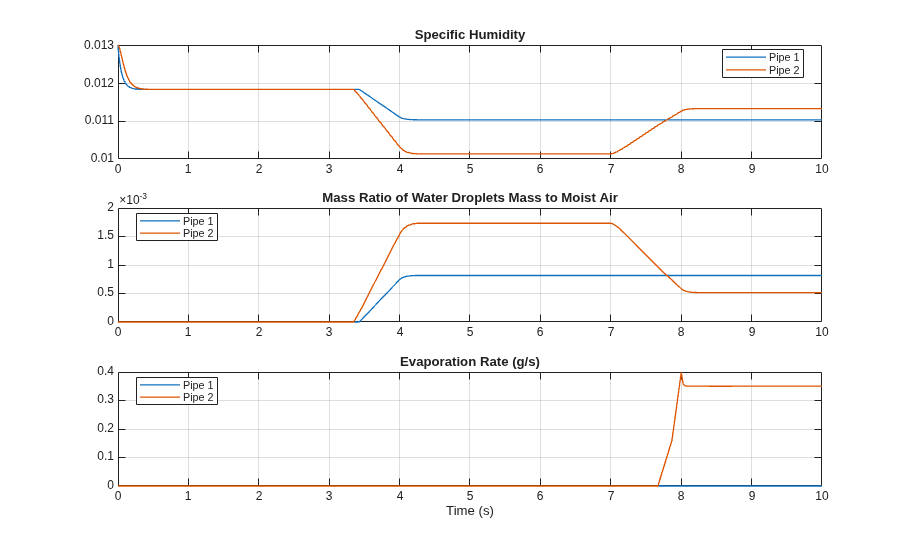
This figure shows the water droplets entrained by the moist air flow due to condensation. At t = 3 s, specific humidity decreases at the same time that the mass ratio of water droplets to moist air increases. At t = 7, the wall temperature increase of the second pipe decreases the relative humidity, causing some water droplets to evaporate back into the moist air flow.
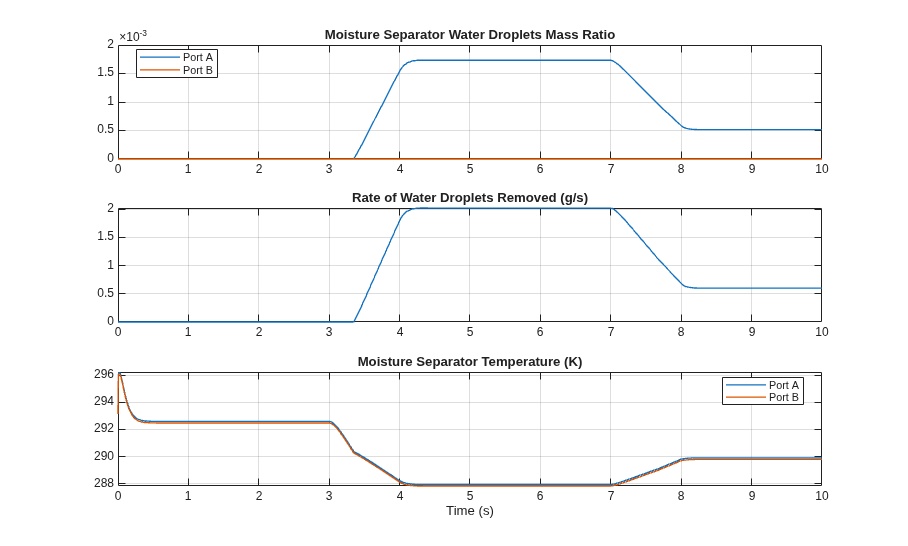
The Moisture Separator (MA) block removes remaining water droplets downstream of the second pipe. This figure shows the amount of water droplets at ports A and B. Because the block removes moisture mechanically, not thermodynamically:
The mass ratio of water droplets at port B is zero, and
Ports A and B have equal temperature.