Contenuto principale

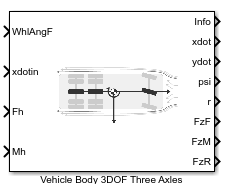
Vehicle Body 3DOF Three Axles

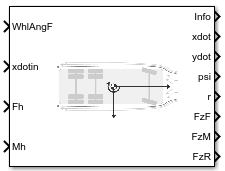
Three-axle vehicle body with longitudinal, lateral, and yaw motion

  • Vehicle Body 3DOF Three Axles block

Libraries:
Vehicle Dynamics Blockset / Vehicle Body

Description

The Vehicle Body 3DOF Three Axles block implements a rigid, three-axle vehicle body model to calculate longitudinal, lateral, and yaw motion. The block accounts for the axle and hitch reaction forces due to the vehicle body mass acceleration, aerodynamic drag, and steering.

This block uses the Vehicle Dynamics Blockset™ Vehicle Coordinate System. The vehicle coordinate system axes (XV, YV, ZV) are fixed in a reference frame attached to the vehicle. The coordinate system conforms to SAE J670 standard with X-forward, Y-right, Z-down orientation with origin at the center of gravity of the sprung mass. Sign convention for steer angle is positive right.

Use this block in vehicle dynamics and automated driving studies to model nonholonomic vehicle motion when vehicle pitch, roll, and vertical motion are not significant.

Use the Vehicle track parameter to specify the number of wheels.

Vehicle Track SettingImplementation

Single (bicycle)

  • Forces act along the center line of the axles.

  • No lateral load transfer.

Dual

Forces act at the axle hard-point locations.

Use the Axle forces parameter to specify the type of force.

Axle Forces SettingImplementation

External longitudinal velocity

  • The block assumes that the external longitudinal velocity is in a quasi-steady state, so the longitudinal acceleration is approximately zero.

  • Because the motion is quasi-steady, the block calculates lateral forces using the tire slip angles and linear cornering stiffness.

  • Consider this setting when you want to:

    • Generate virtual sensor signal data.

    • Conduct high-level software studies that are not impacted by driveline or nonlinear tire responses.

External longitudinal forces

  • The block uses the external longitudinal force to accelerate or brake the vehicle.

  • The block calculates lateral forces using the tire slip angles and linear cornering stiffness.

  • Consider this setting when you want to:

    • Account for changes in the longitudinal velocity on the lateral and yaw motion.

    • Specify the external longitudinal motion through a force instead of an external longitudinal velocity.

    • Connect the block to tractive actuators, wheels, brakes, and hitches.

External forces

  • The block uses the external lateral and longitudinal forces to steer, accelerate, or brake the vehicle.

  • The block does not use the steering input to calculate vehicle motion.

  • Consider this setting when you need tire models with more accurate nonlinear combined lateral and longitudinal slip.

To create additional input ports, under Input signals, select these block parameters.

Input Signals Pane Parameter

Input PortDescription

Front wheel steering

WhlAngF

Front wheel angle, δF

Middle wheel steeringWhlAngM

Middle wheel angle, δM

Rear wheel steeringWhlAngR

Rear wheel angle, δR

External wind

WindXYZ

Wind speed, WX, WY, and WZ, in an inertial reference frame

External frictionMu

Friction coefficient

External forcesFExt

External force on the vehicle center of gravity (CG), Fx, Fy, and Fz, in the vehicle-fixed frame

External moments

MExt

External moment about the vehicle CG, Mx, My, and Mz, in the vehicle-fixed frame

Rear hitch forcesFhR

Hitch force applied to the body at the rear hitch location, FhRx, FhRy, and FhRz, in the vehicle-fixed frame

Rear hitch momentsMhR

Hitch moment at the rear hitch location, MhRx, MhRy, and MhRz, about the vehicle-fixed frame

Initial longitudinal position

X_o

Initial vehicle CG displacement along the earth-fixed X-axis

Initial yaw angle

psi_o

Initial rotation of the vehicle-fixed frame about the earth-fixed Z-axis (yaw)

Initial longitudinal velocity

xdot_o

Initial vehicle CG velocity along the vehicle-fixed x-axis

Initial yaw rate

r_o

Initial vehicle angular velocity about the vehicle-fixed z-axis (yaw rate)

Initial lateral position

Y_o

Initial vehicle CG displacement along the earth-fixed Y-axis

Air temperature

AirTemp

Ambient air temperature. Consider this option if you want to vary the temperature during run time.

Initial lateral velocity

ydot_o

Initial vehicle CG velocity along the vehicle-fixed y-axis

Equations of Motion

To determine the vehicle motion, the block solves the rigid body planar dynamics equations of motion.

Single Track

CalculationDescription

Dynamics

The block solves the rigid-body planar dynamics equations to determine the vehicle longitudinal motion.

y¨=x˙r+Fyf+Fym+Fyr+Fyext+Fyhmr˙=aFyfbFymcFyrdhFyh+Mzext+MzhIzzr=ψ˙

If you set Axle forces to either External longitudinal forces or External forces, the block uses this equation for the longitudinal acceleration.

x¨=y˙r+Fxf+Fxm+Fxrgsin(γ)+Fxext+Fxhm

If you set Axle forces to External longitudinal velocity, the block assumes a quasi-steady state for the longitudinal acceleration.

x¨=0

External forces

External forces include both drag and external force inputs. The forces act on the vehicle CG.

Fx,y,z ext=Fd x,y,z+Fx,y,z inputMx,y,z ext=Md x,y,z+Mx,y,z input

If you set Axle forces to External longitudinal forces, the block uses these equations.

Fxft=FxfinputFyft=CyfαfμfFzfFznomFxmt=FxminputFymt=CymαmμmFzmFznomFxrt=FxrinputFyrt=CyrαrμrFzrFznom 

If you set Axle forces to External longitudinal velocity, the block uses these equations.

Fxft=0Fyft=CyfαfμfFzfFznomFxmt=0Fymt=CymαmμmFzmFznomFxrt=0Fyrt=CyrαrμrFzrFznom

The block divides the normal forces by the nominal normal load to vary the effective friction parameters during weight and load transfer. The block maintains pitch and roll equilibrium.

Fzf=bmgcos(γ)(x¨y˙r)mh+hFxext+bFzextMyexta+bFzr=amgcos(γ)+(x¨y˙r)mhhFxext+aFzext+Myexta+b

Tire forces

The block uses the ratio of the local, longitudinal, and lateral velocities to determine the slip angles.

αf=atan(y˙+arx˙)δfαm=atan(y˙brx˙)δmαr=atan(y˙crx˙)δr

The block uses the steering angles to transform the tire forces to the vehicle-fixed frame.

Fxf=Fxftcos(δf)Fyftsin(δf)Fyf=Fxftsin(δf)+Fyftcos(δf)Fxm=Fxmtcos(δm)Fymtsin(δm)Fym=Fxmtsin(δm)+Fymtcos(δm)Fxr=Fxrtcos(δr)Fyrtsin(δr)Fyr=Fxrtsin(δr)+Fyrtcos(δr)

If you set Axle forces to External forces, the block assumes that the externally provided forces are in the vehicle-fixed frame at the axle-wheel location.

Fxf=Fxft=FxfinputFyf=Fyft=FyfinputFxm=Fxmt=FxminputFym=Fymt=FyminputFxr=Fxrt=FxrinputFyr=Fyrt=Fyrinput

Dual Track

CalculationDescription

Dynamics

The block solves the rigid-body planar dynamics equations to determine the vehicle longitudinal motion.

x¨=y˙r+Fxfl+Fxfr+Fxml+Fxmr+Fxrl+Fxrrgsin(γ)+Fxext+Fhxmy¨=x˙r+Fyfl+Fyfr+Fyml+Fymr+Fyrl+Fyrr+Fyext+Fhymr˙=a(Fyfl+Fyfr)b(Fyml+Fymr)c(Fyrl+Fyrr)dhFhy+Fxfl(wf2+d)Fxfr(wf2d)+Fxml(wm2+d)Fxmr(wm2d)+Fxrl(wr2+d)Fxrr(wr2d)+Mzext+MhzFhxhlIzzr=ψ˙

If you set Axle forces to External longitudinal velocity, the block assumes a quasi-steady state for the longitudinal acceleration.

x¨=0

External forces

External forces include both drag and external force inputs. The forces act on the vehicle CG.

Fx,y,z ext=Fd x,y,z+Fx,y,z inputMx,y,z ext=Md x,y,z+Mx,y,z input

If you set Axle forces to External longitudinal forces, the block uses these equations.

Fxflt=FxflinputFyflt=CyflαflμflFzfl2FznomFxfrt=FxfrinputFyfrt=CyfrαfrμfrFzfr2FznomFxmlt=FxmlinputFymlt=CymlαmlμmlFzml2FznomFxmrt=FxmrinputFymrt=CymrαmrμmrFzmr2FznomFxrlt=FxrlinputFyrlt=CyrlαrlμrlFzrl2Fznom Fxrrt=FxrrinputFyrrt=CyrrαrrμrrFzrr2Fznom 

If you set Axle forces to External longitudinal velocity, the block uses these equations.

Fxflt=0Fyflt=CyflαflμflFzfl2FznomFxfrt=0Fyfrt=CyfrαfrμfrFzfr2FznomFxmlt=0Fymlt=CymlαmlμmlFzml2FznomFxmrt=0Fymrt=CymrαmrμmrFzmr2FznomFxrlt=0Fyrlt=CyrlαrlμrlFzrl2FznomFxrrt=0Fyrrt=CyrrαrrμrrFzrr2Fznom

The block divides the normal forces by the nominal normal load to vary the effective friction parameters during weight and load transfer. The block maintains pitch and roll equilibrium.

Fzf=bmgcos(γ)(x¨y˙r)mh+hFxext+bFzextMyexta+bFzr=amgcos(γ)+(x¨y˙r)mhhFxext+aFzext+Myext(a+b)Fzfl=Fzf+(mh(y¨+x˙r)hFyextMxext)2wfFzfr=Fzf+(mh(y¨+x˙r)+hFyext+Mxext)2wfFzrl=Fzr+(mh(y¨+x˙r)hFyextMxext)2wrFzrr=Fzr+(mh(y¨+x˙r)+hFyext+Mxext)2wr

Tire forces

The block uses the ratio of the local, longitudinal, and lateral velocities to determine the slip angles.

αfl=atan(y˙+arx˙+rwf2)δflαfr=atan(y˙+arx˙rwf2)δfrαml=atan(y˙brx˙+rwm2)δmlαmr=atan(y˙brx˙rwm2)δmrαrl=atan(y˙crx˙+rwr2)δrlαrr=atan(y˙crx˙rwr2)δrr

The block uses the steering angles to transform the tire forces to the vehicle-fixed frame.

Fxfl=Fxfltcos(δfl)Fyfltsin(δfl)Fxfr=Fxfrtcos(δfr)Fyfrtsin(δfr)Fxml=Fxmltcos(δml)Fymltsin(δml)Fxmr=Fxmrtcos(δmr)Fymrtsin(δmr)Fyfl=Fxfltsin(δfl)+Fyfltcos(δfl)Fyfr=Fxfrtsin(δfr)+Fyfrtcos(δfr)Fyml=Fxmltsin(δml)+Fymltcos(δml)Fymr=Fxmrtsin(δmr)+Fymrtcos(δmr)Fxrl=Fxrltcos(δrl)Fyrltsin(δrl)Fxrr=Fxrrtcos(δrr)Fyrrtsin(δrr)Fyrl=Fxrltsin(δrl)+Fyrltcos(δrl)Fyrr=Fxrrtsin(δrr)+Fyrrtcos(δrr)

If you set Axle forces to External forces, the block assumes that the externally provided forces are in the vehicle-fixed frame at the axle-wheel location.

Fxfl=Fxflt=FxflinputFxfr=Fxfrt=FxfrinputFxml=Fxmlt=FxmlinputFxmr=Fxmrt=FxmrinputFyfl=Fyflt=FyflinputFyfr=Fyfrt=FyfrinputFyml=Fymlt=FymlinputFymr=Fymrt=FymrinputFxrl=Fxrlt=FxrlinputFxrr=Fxrrt=FxrrinputFyrl=Fyrlt=FyrlinputFyrr=Fyrrt=Fyrrinput

The illustrations use these variables.

a, b, c

Longitudinal distance of the front, middle, and rear axles, respectively, from the normal projection point of the vehicle CG onto the common axle plane

h

Height of vehicle CG above the axle plane along the vehicle-fixed z-axis

d

Lateral distance from geometric centerline to center of mass along the vehicle-fixed y-axis

hh

Height of the hitch above the axle plane along the vehicle-fixed z-axis

dh

Longitudinal distance of the hitch from normal projection point of the vehicle CG onto the common axle plane

hl

Lateral distance from center of mass to hitch along the vehicle-fixed y-axis.

wf, wm, wr

Front, middle, and rear track width, respectively

Drag

This table summarizes the block implementation for the drag calculation.

CalculationDescription

Coordinate transformation

The block transforms the wind speeds from the inertial frame to the vehicle-fixed frame.

wx=Wxcos(ψ)+Wysin(ψ)wy=Wycos(ψ)Wxsin(ψ)wz=Wz

Drag forces

To determine a relative airspeed, the block subtracts the wind speed from the CG vehicle velocity. Using the relative airspeed, the block determines the drag forces.

w¯=(x˙wx)2+(y˙wy)2+(z˙wz)2Fdx=12TRCdAfPabs(w¯)2Fdy=12TRCsAfPabs(w¯)2Fdz=12TRClAfPabs(w¯)2

Drag moments

Using the relative airspeed, the block determines the drag moments.

Mdr=12TRCrmAfPabs(w¯)2(dh+c)Mdp=12TRCpmAfPabs(w¯)2(dh+c)Mdy=12TRCymAfPabs(w¯)2(dh+c)

Lateral Corner Stiffness and Relaxation Dynamics

To enable the mapped corner stiffness and relaxation length dynamic parameters, set Axle forces to External longitudinal force or External longitudinal velocity.

Parameter SettingsDescription
Mapped Corner StiffnessInclude Relaxation Length Dynamics

Off (default)

On (default)

The block uses constant corner stiffness values for Cyf, Cym, and Cyr.

The slip angles include the relaxation length dynamic settings. The relaxation length approximates an effective corner stiffness force that is a function of wheel travel.

On

On (default)

The block uses lookup tables that are functions of the corner stiffness data and slip angles.

Cyf=f(αfσ,Cyfdata)Cym=f(αmσ,Cymdata)Cyr=f(αrσ,Cyrdata)αfσ=1s[(αfαfσ)vwfαf]αmσ=1s[(αmαmσ)vmfαm]αrσ=1s[(αrαrσ)vwrαr]

The slip angles include the relaxation length dynamic settings. The relaxation length approximates an effective corner stiffness force that is a function of wheel travel.

Off (default)

Off

The block uses constant corner stiffness values Cyf, Cym and Cyr.

The equations use these variables.

x,x˙,x¨

Vehicle CG displacement, velocity, and acceleration, along the vehicle-fixed x-axis

y,y˙,y¨

Vehicle CG displacement, velocity, and acceleration, along the vehicle-fixed y-axis

ψ

Rotation of the vehicle-fixed frame about the earth-fixed Z-axis (yaw)

r,Ψ˙

Vehicle angular velocity, about the vehicle-fixed z-axis (yaw rate)

Fxf, Fxm, Fxr

Longitudinal forces applied to front, middle, and rear wheels, along the vehicle-fixed x-axis

Fyf, Fym, Fyr

Lateral forces applied to front, middle, and rear wheels, along vehicle-fixed y-axis

Fxext, Fyext, Fzext

External forces applied to vehicle CG, along the vehicle-fixed x-, y-, and z-axes

Fdx, Fdy, Fdz

Drag forces applied to vehicle CG, along the vehicle-fixed x-, y-, and z-axes

Fxinput, Fyinput, Fzinput

Input forces applied to vehicle CG, along the vehicle-fixed x-, y-, and z-axes

Mxext, Myext, Mzext

External moment about vehicle CG, about the vehicle-fixed x-, y-, and z-axes

Mdx, Mdy, Mdz

Drag moment about vehicle CG, about the vehicle-fixed x-, y-, and z-axes

Mxinput, Myinput, Mzinput

Input moment about vehicle CG, about the vehicle-fixed x-, y-, and z-axes

Izz

Vehicle body moment of inertia about the vehicle-fixed z-axis

Fxft, Fxmt, Fxrt

Longitudinal tire force applied to front, middle, and rear wheels, along the vehicle-fixed x-axis

Fyft, Fymt, Fyrt

Lateral tire force applied to front, middle, and rear wheels, along vehicle-fixed y-axis

Fxfl, Fxfr

Longitudinal force applied to front left and front right wheels, along the vehicle-fixed x-axis

Fyfl, Fyfr

Lateral force applied to front left and front right wheels, along the vehicle-fixed y-axis

Fxrl, Fxrr

Longitudinal force applied to rear left and rear right wheels, along the vehicle-fixed x-axis

Fyrl, Fyrr

Lateral force applied to rear left and rear right wheels, along the vehicle-fixed y-axis

Fxflt, Fxfrt

Longitudinal tire force applied to front left and front right wheels, along the vehicle-fixed x-axis

Fxmlt, Fxmrt

Longitudinal tire force applied to middle left and middle right wheels, along the vehicle-fixed x-axis

Fxrlt, Fxrrt

Longitudinal tire force applied to rear left and rear right wheels, along the vehicle-fixed x-axis

Fyflt, Fyfrt

Lateral force tire applied to front left and front right wheels, along the vehicle-fixed y-axis

Fymlt, Fymrt

Lateral force tire applied to middle left and middle right wheels, along the vehicle-fixed y-axis

Fyrlt, Fyrrt

Lateral force applied to rear left and rear right wheels, along the vehicle-fixed y-axis

Fzf,Fzr

Normal force applied to front and rear wheels, along vehicle-fixed z-axis

Fznom

Nominal normal force applied to axles, along the vehicle-fixed z-axis

Fzfl,Fzfr

Normal force applied to front left and right wheels, along vehicle-fixed z-axis

Fzrl,Fzrr

Normal force applied to rear left and right wheels, along vehicle-fixed z-axis

m

Vehicle body mass

a, b

Distance of front and rear wheels, respectively, from the normal projection point of vehicle CG onto the common axle plane

h

Height of vehicle CG above the axle plane

d

Lateral distance from the geometric centerline to the center of mass along the vehicle-fixed y-axis

hh

Height of the hitch above the axle plane along the vehicle-fixed z-axis

dh

Longitudinal distance of the hitch from the normal projection point of tractor CG onto the common axle plane

hl

Lateral distance from center of mass to hitch along the vehicle-fixed y-axis.

αf, αr

Front and rear wheel slip angles

αfl, αfr

Front left and right wheel slip angles

αrl, αrr

Rear left and right wheel slip angles

δf, δr

Front and rear wheel steering angles

δrl, δrr

Rear left and right wheel steering angles

δfl, δfr

Front left and right wheel steering angles

wf, wr

Front and rear track widths

Cyf, Cyr

Front and rear wheel cornering stiffness

Cyfdata, Cyrdata

Front and rear wheel cornering stiffness data

σf, σr

Front and rear wheel relaxation length

α, αFront and rear wheel slip angles that include relaxation length
vwf, vwrMagnitude of front and rear wheel hardpoint velocity
μf, μr

Front and rear wheel friction coefficient

μfl, μfr

Front left and right wheel friction coefficient

μrl, μrr

Rear left and right wheel friction coefficient

Cd

Air drag coefficient acting along vehicle-fixed x-axis

Cs

Air drag coefficient acting along vehicle-fixed y-axis

ClAir drag coefficient acting along vehicle-fixed z-axis
Crm

Air drag roll moment acting about the vehicle-fixed x-axis

Cpm

Air drag pitch moment acting about the vehicle-fixed y-axis

Cym

Air drag yaw moment acting about the vehicle-fixed z-axis

Af

Frontal area

RAtmospheric specific gas constant
TEnvironmental air temperature
PabsEnvironmental absolute pressure
wx, wy, wz

Wind speed, along the vehicle-fixed x-, y-, and z-axes

Wx, Wy, Wz

Wind speed, along inertial X-, Y-, and Z-axes

Examples

Ports

Input

expand all

Front wheel steering angles, δF, in rad.

Vehicle Track Setting

Variable

Signal Dimension

Single (bicycle)δF

Scalar – 1

Dual

δF=[δflδfr]  or  [δflδfr]

Array – [1x2] or [2x1]

Dependencies

To enable this port, on the Input signals pane, select Front wheel steering.

Middle wheel steering angles, δM, in rad.

Vehicle Track Setting

Variable

Signal Dimension

Single (bicycle)δM

Scalar – 1

Dual

δM=[δmlδmr]  or  [δmlδmr]

Array – [1x2] or [2x1]

Dependencies

To enable this port, on the Input signals pane, select Middle wheel steering.

Rear wheel steering angles, δR, in rad.

Vehicle Track Setting

Variable

Signal Dimension

Single (bicycle)δR

Scalar – 1

Dual

δR=[δrlδrr]  or  [δrlδrr]

Array – [1x2] or [2x1]

Dependencies

To enable this port, on the Input signals pane, select Rear wheel steering.

Vehicle CG velocity along the vehicle-fixed x-axis, in m/s.

Dependencies

To enable this port, set Axle forces to External longitudinal velocity.

Force on the front wheels, FwF, along the vehicle-fixed axis, in N.

Vehicle Track Setting

Axle Forces Setting

Description

Variable

Signal Dimension

Single (bicycle)External longitudinal forces

Longitudinal force on the front wheel

FwF=Fxf

Scalar – 1

External forces

Longitudinal and lateral forces on the front wheel

FwF=[FxfFyf]  or [FxfFyf]

Array – [1x2] or [2x1]

DualExternal longitudinal forces

Longitudinal force on the front wheels

FwF=[FxflFxfr] or [FxflFxfr]

Array – [1x2] or [2x1]

External forces

Longitudinal and lateral forces on the front wheels

FwF=[FxflFyflFxfrFyfr]

Array – [2x2]

Dependencies

To enable this port, set Axle forces to one of these options:

  • External longitudinal forces

  • External forces

Force on the middle wheels, FwM, along the vehicle-fixed axis, in N.

Vehicle Track Setting

Axle Forces Setting

Description

Variable

Signal Dimension

Single (bicycle)External longitudinal forces

Longitudinal force on the middle wheel

FwM=Fxr

Scalar – 1

External forces

Longitudinal and lateral forces on the middle wheel

FwM=[FxmFym]  or [FxmFym]

Array – [1x2] or [2x1]

DualExternal longitudinal forces

Longitudinal force on the middle wheels

FwM=[FxmlFxmr] or [FxmlFxmr]

Array – [1x2] or [2x1]

External forces

Longitudinal and lateral forces on the middle wheels

FwM=[FxmlFxmrFymlFymr]

Array – [2x2]

Dependencies

To enable this port, set Axle forces to one of these options:

  • External longitudinal forces

  • External forces

Force on the rear wheels, FwR, along the vehicle-fixed axis, in N.

Vehicle Track Setting

Axle Forces Setting

Description

Variable

Signal Dimension

Single (bicycle)External longitudinal forces

Longitudinal force on the rear wheel

FwR=Fxr

Scalar – 1

External forces

Longitudinal and lateral forces on the rear wheel

FwR=[FxrFyr]  or [FxrFyr]

Array – [1x2] or [2x1]

DualExternal longitudinal forces

Longitudinal force on the rear wheels

FwR=[FxrlFxrr] or [FxrlFxrr]

Array – [1x2] or [2x1]

External forces

Longitudinal and lateral forces on the rear wheels

FwR=[FxrlFyrlFxrrFyrr]

Array – [2x2]

Dependencies

To enable this port, set Axle forces to one of these options:

  • External longitudinal forces

  • External forces

External forces applied to the vehicle CG, Fxext, Fyext, Fzext, in vehicle-fixed frame, in N. The signal array dimensions are [1x3] or [3x1].

Dependencies

To enable this port, on the Input signals pane, select External forces.

External moment about the vehicle CG, Mx, My, Mz, in the vehicle-fixed frame, in N·m. The signal array dimensions are [1x3] or [3x1].

Dependencies

To enable this port, on the Input signals pane, select External moments.

Hitch force applied to the body at the hitch location, Fhx, Fhy, Fhz, in the vehicle-fixed frame, in N, specified as a 1-by-3 or 3-by-1 array.

Dependencies

To enable this port, under Input signals, select Rear hitch forces.

Hitch moment at the hitch location, Mhx, Mhy, Mhz, about the vehicle-fixed frame, in N·m, specified as a 1-by-3 or 3-by-1 array.

Dependencies

To enable this port, under Input signals, select Rear hitch moments.

Wind speed, Wx, Wy, Wz along the inertial X-, Y-, and Z-axes, in m/s. The signal array dimensions are [1x3] or [3x1].

Dependencies

To enable this port, on the Input signals pane, select External wind.

Tire friction coefficient, μ, dimensionless.

Vehicle Track Setting

Variable

Signal Dimension

Single (bicycle)

Mu=[μfμmμr] or [μfμmμr]

Array – [1x3] or [3x1]

Dual

Mu=[μflμfrμmlμmrμrlμrr]

Array – [3x2]

Dependencies

To enable this port, on the Input signals pane, select External friction.

Ambient air temperature, in K.

Dependencies

To enable this port, on the Input signals pane, select Air temperature.

Initial vehicle CG displacement along the earth-fixed X-axis, in m.

Dependencies

To enable this port, on the Input signals pane, select Initial longitudinal position.

Initial vehicle CG displacement along the earth-fixed Y-axis, in m.

Dependencies

To enable this port, on the Input signals pane, select Initial lateral position.

Initial vehicle CG velocity along the vehicle-fixed x-axis, in m/s.

Dependencies

To enable this port:

  1. Set Axle forces to one of these options:

    • External longitudinal forces

    • External forces

  2. On the Input signals pane, select Initial longitudinal velocity

Initial vehicle CG velocity along the vehicle-fixed y-axis, in m/s.

Dependencies

To enable this port, on the Input signals pane, select Initial lateral velocity.

Rotation of the vehicle-fixed frame about the earth-fixed Z-axis (yaw), in rad.

Dependencies

To enable this port, on the Input signals pane, select Initial yaw angle.

Vehicle angular velocity about the vehicle-fixed z-axis (yaw rate), in rad/s.

Dependencies

To enable this port, on the Input signals pane, select Initial yaw rate.

Output

expand all

Vehicle data, returned as a bus signal containing these block values.

SignalDescriptionValueUnits
InertFrmCgDispXVehicle CG displacement along the earth-fixed X-axis

Computed

m
YVehicle CG displacement along the earth-fixed Y-axis

Computed

m

ZVehicle CG displacement along the earth-fixed Z-axis0m
VelXdotVehicle CG velocity along the earth-fixed X-axis

Computed

m/s

YdotVehicle CG velocity along the earth-fixed Y-axis

Computed

m/s
ZdotVehicle CG velocity along the earth-fixed Z-axis0m/s
AngphiRotation of the vehicle-fixed frame about the earth-fixed X-axis (roll)0rad
thetaRotation of the vehicle-fixed frame about the earth-fixed Y-axis (pitch)0rad
psiRotation of the vehicle-fixed frame about the earth-fixed Z-axis (yaw)

Computed

rad
FrntAxlLftDispXFront left wheel displacement along the earth-fixed X-axis

Computed

m
YFront left wheel displacement along the earth-fixed Y-axis

Computed

m
ZFront left wheel displacement along the earth-fixed Z-axis0m
VelXdotFront left wheel velocity along the earth-fixed X-axis

Computed

m/s
YdotFront left wheel velocity along the earth-fixed Y-axis

Computed

m/s
ZdotFront left wheel velocity along the earth-fixed Z-axis0m/s
RghtDispXFront right wheel displacement along the earth-fixed X-axis

Computed

m
YFront right wheel displacement along the earth-fixed Y-axis

Computed

m
ZFront right wheel displacement along the earth-fixed Z-axis0m
VelXdotFront right wheel velocity along the earth-fixed X-axis

Computed

m/s
YdotFront right wheel velocity along the earth-fixed Y-axis

Computed

m/s
ZdotFront right wheel velocity along the earth-fixed Z-axis0m/s
MidlAxlLftDispXMiddle left wheel displacement along the earth-fixed X-axis

Computed

m
YMiddle left wheel displacement along the earth-fixed Y-axis

Computed

m
ZMiddle left wheel displacement along the earth-fixed Z-axis0m
VelXdotMiddle left wheel velocity along the earth-fixed X-axis

Computed

m/s
YdotMiddle left wheel velocity along the earth-fixed Y-axis

Computed

m/s
ZdotMiddle left wheel velocity along the earth-fixed Z-axis0m/s
RghtDispXMiddle right wheel displacement along the earth-fixed X-axis

Computed

m
YMiddle right wheel displacement along the earth-fixed Y-axis

Computed

m
ZMiddle right wheel displacement along the earth-fixed Z-axis0m
VelXdotMiddle right wheel velocity along the earth-fixed X-axis

Computed

m/s
YdotMiddle right wheel velocity along the earth-fixed Y-axis

Computed

m/s
ZdotMiddle right wheel velocity along the earth-fixed Z-axis0m/s
RearAxlLftDispXRear left wheel displacement along the earth-fixed X-axis

Computed

m
YRear left wheel displacement along the earth-fixed Y-axis

Computed

m
ZRear left wheel displacement along the earth-fixed Z-axis0m
VelXdotRear left wheel velocity along the earth-fixed X-axis

Computed

m/s
YdotRear left wheel velocity along the earth-fixed Y-axis

Computed

m/s
ZdotRear left wheel velocity along the earth-fixed Z-axis0m/s
RghtDispXRear right wheel displacement along the earth-fixed X-axis

Computed

m
YRear right wheel displacement along the earth-fixed Y-axis

Computed

m
ZRear right wheel displacement along the earth-fixed Z-axis0m
VelXdotRear right wheel velocity along the earth-fixed X-axis

Computed

m/s
YdotRear right wheel velocity along the earth-fixed Y-axis

Computed

m/s
ZdotRear right wheel velocity along the earth-fixed Z-axis0m/s
HitchDispXTrailer hitch offset from the axle plane along the earth-fixed X-axis

Computed

m
YTrailer hitch offset from the center plane along the earth-fixed Y-axis

Computed

m
ZTrailer hitch offset from the axle plane along the earth-fixed Z-axis

Computed

m
VelXdotTrailer hitch offset velocity along the earth-fixed X-axis

Computed

m/s
YdotTrailer hitch offset velocity along the earth-fixed Y-axis

Computed

m/s
ZdotTrailer hitch offset velocity along the earth-fixed Z-axis

Computed

m/s
GeomDispXVehicle chassis offset from axle plane along the earth-fixed X-axis

Computed

m
YVehicle chassis offset from center plane along the earth-fixed Y-axis

Computed

m
ZVehicle chassis offset from axle plane along the earth-fixed Z-axis

Computed

m
VelXdotVehicle chassis offset velocity along the earth-fixed X-axis

Computed

m/s
YdotVehicle chassis offset velocity along the earth-fixed Y-axis

Computed

m/s
ZdotVehicle chassis offset velocity along the earth-fixed Z-axis

Computed

m/s
BdyFrmCgVelxdotVehicle CG velocity along the vehicle-fixed x-axis

Computed

m/s
ydotVehicle CG velocity along the vehicle-fixed y-axis

Computed

m/s
zdotVehicle CG velocity along the vehicle-fixed z-axis0m/s
AngBeta

Body slip angle, β

β=VyVx

Computed

rad
AngVelpVehicle angular velocity about the vehicle-fixed x-axis (roll rate)0rad/s
qVehicle angular velocity about the vehicle-fixed y-axis (pitch rate)0rad/s
rVehicle angular velocity about the vehicle-fixed z-axis (yaw rate)

Computed

rad/s
AccaxVehicle CG acceleration along the vehicle-fixed x-axis

Computed

gn
ayVehicle CG acceleration along the vehicle-fixed y-axis

Computed

gn
azVehicle CG acceleration along the vehicle-fixed z-axis0gn
xddotVehicle CG acceleration along the vehicle-fixed x-axis

Computed

m/s^2
yddotVehicle CG acceleration along the vehicle-fixed y-axis

Computed

m/s^2
zddotVehicle CG acceleration along the vehicle-fixed z-axis0m/s^2
AngAccpdotVehicle angular acceleration about the vehicle-fixed x-axis0rad/s
qdotVehicle angular acceleration about the vehicle-fixed y-axis0rad/s
rdotVehicle angular acceleration about the vehicle-fixed z-axis

Computed

rad/s
ForcesBodyFxNet force on vehicle CG along the vehicle-fixed x-axis

Computed

N
FyNet force on vehicle CG along the vehicle-fixed y-axis

Computed

N
FzNet force on vehicle CG along the vehicle-fixed z-axis0N
ExtFxExternal force on vehicle CG along the vehicle-fixed x-axis

Computed

N
FyExternal force on vehicle CG along the vehicle-fixed y-axis

Computed

N
FzExternal force on vehicle CG along the vehicle-fixed z-axis0N
HitchFx

Hitch force applied to body at the hitch location along the vehicle-fixed x-axis

Computed

N
Fy

Hitch force applied to body at the hitch location along the vehicle-fixed y-axis

Computed

N
Fz

Hitch force applied to body at the hitch location along the vehicle-fixed z-axis

Computed

N
FrntAxlLftFx

Longitudinal force on left front wheel along the vehicle-fixed x-axis

Computed

N
Fy

Lateral force on left front wheel along the vehicle-fixed y-axis

Computed

N
Fz

Normal force on left front wheel along the vehicle-fixed z-axis

Computed

N
RghtFx

Longitudinal force on right front wheel along the vehicle-fixed x-axis

Computed

N
Fy

Lateral force on right front wheel along the vehicle-fixed y-axis

Computed

N
Fz

Normal force on right front wheel along the vehicle-fixed z-axis

ComputedN
MidlAxlLftFx

Longitudinal force on left middle wheel along the vehicle-fixed x-axis

Computed

N
Fy

Lateral force on left middle wheel along the vehicle-fixed y-axis

Computed

N
Fz

Normal force on left middle wheel along the vehicle-fixed z-axis

Computed

N
RghtFx

Longitudinal force on right middle wheel along the vehicle-fixed x-axis

Computed

N
Fy

Lateral force on right middle wheel along the vehicle-fixed y-axis

Computed

N
Fz

Normal force on right middle wheel along the vehicle-fixed z-axis

ComputedN
RearAxlLftFx

Longitudinal force on left rear wheel along the vehicle-fixed x-axis

Computed

N
Fy

Lateral force on left rear wheel along the vehicle-fixed y-axis

Computed

N
Fz

Normal force on left rear wheel along the vehicle-fixed z-axis

ComputedN
RghtFx

Longitudinal force on right rear wheel along the vehicle-fixed x-axis

Computed

N
Fy

Lateral force on right rear wheel along the vehicle-fixed y-axis

Computed

N
Fz

Normal force on right rear wheel along the vehicle-fixed z-axis

ComputedN
TiresFrntTiresLftFx

Front left tire force along the vehicle-fixed x-axis

ComputedN
Fy

Front left tire force along the vehicle-fixed y-axis

ComputedN
Fz

Front left tire force along the vehicle-fixed z-axis

ComputedN
RghtFx

Front right tire force along the vehicle-fixed x-axis

ComputedN
Fy

Front right tire force along the vehicle-fixed y-axis

ComputedN
Fz

Front right tire force along the vehicle-fixed z-axis

ComputedN
RearTiresLftFx

Rear left tire force along the vehicle-fixed x-axis

ComputedN
Fy

Rear left tire force along the vehicle-fixed y-axis

ComputedN
Fz

Rear left tire force along the vehicle-fixed z-axis

ComputedN
RghtFx

Rear right tire force along the vehicle-fixed x-axis

ComputedN
Fy

Rear right tire force along the vehicle-fixed y-axis

ComputedN
Fz

Rear right tire force along the vehicle-fixed z-axis

Computed 
DragFxDrag force on vehicle CG along the vehicle-fixed x-axis

Computed

N
FyDrag force on vehicle CG along the vehicle-fixed y-axis

Computed

N
FzDrag force on vehicle CG along the vehicle-fixed z-axis

Computed

N
GrvtyFxGravity force on vehicle CG along the vehicle-fixed x-axis

Computed

N
FyGravity force on vehicle CG along the vehicle-fixed y-axis

Computed

N
FzGravity force on vehicle CG along the vehicle-fixed z-axis

Computed

N
MomentsBodyMxBody moment on vehicle CG about the vehicle-fixed x-axis0N·m
MyBody moment on vehicle CG about the vehicle-fixed y-axis

Computed

N·m
MzBody moment on vehicle CG about the vehicle-fixed z-axis0N·m
DragMxDrag moment on vehicle CG about the vehicle-fixed x-axis0N·m
MyDrag moment on vehicle CG about the vehicle-fixed y-axis

Computed

N·m
MzDrag moment on vehicle CG about the vehicle-fixed z-axis0N·m
ExtMxExternal moment on vehicle CG about the vehicle-fixed x-axis0N·m
MyExternal moment on vehicle CG about the vehicle-fixed y-axis

Computed

N·m
MzExternal moment on vehicle CG about the vehicle-fixed z-axis0N·m
HitchMxHitch moment at the hitch location about vehicle-fixed x-axis0N·m
MyHitch moment at the hitch location about vehicle-fixed y-axis

Computed

N·m
MzHitch moment at the hitch location about vehicle-fixed z-axis0N·m
FrntAxlLftDispxFront left wheel displacement along the vehicle-fixed x-axis

Computed

m
yFront left wheel displacement along the vehicle-fixed y-axisComputedm
zFront left wheel displacement along the vehicle-fixed z-axis

Computed

m
VelxdotFront left wheel velocity along the vehicle-fixed x-axis

Computed

m/s
ydotFront left wheel velocity along the vehicle-fixed y-axis

Computed

m/s
zdotFront left wheel velocity along the vehicle-fixed z-axis0m/s
RghtDispxFront right wheel displacement along the vehicle-fixed x-axis

Computed

m
yFront right wheel displacement along the vehicle-fixed y-axisComputedm
zFront right wheel displacement along the vehicle-fixed z-axis

Computed

m
VelxdotFront right wheel velocity along the vehicle-fixed x-axis

Computed

m/s
ydotFront right wheel velocity along the vehicle-fixed y-axis

Computed

m/s
zdotFront right wheel velocity along the vehicle-fixed z-axis0m/s
SteerWhlAngFL

Front left wheel steering angle

Computed

rad
WhlAngFR

Front right wheel steering angle

Computed

rad
MidlAxlLftDispxMiddle left wheel displacement along the vehicle-fixed x-axis

Computed

m
yMiddle left wheel displacement along the vehicle-fixed y-axisComputedm
zMiddle left wheel displacement along the vehicle-fixed z-axis

Computed

m
VelxdotMiddle left wheel velocity along the vehicle-fixed x-axis

Computed

m/s
ydotMiddle left wheel velocity along the vehicle-fixed y-axis

Computed

m/s
zdotMiddle left wheel velocity along the vehicle-fixed z-axis0m/s
RghtDispxMiddle right wheel displacement along the vehicle-fixed x-axis

Computed

m
yMiddle right wheel displacement along the vehicle-fixed y-axisComputedm
zMiddle right wheel displacement along the vehicle-fixed z-axis

Computed

m
VelxdotMiddle right wheel velocity along the vehicle-fixed x-axis

Computed

m/s
ydotMiddle right wheel velocity along the vehicle-fixed y-axis

Computed

m/s
zdotMiddle right wheel velocity along the vehicle-fixed z-axis0m/s
SteerWhlAngRL

Middle left wheel steering angle

Computed

rad
WhlAngRR

Middle right wheel steering angle

Computed

rad
RearAxlLftDispxRear left wheel displacement along the vehicle-fixed x-axis

Computed

m
yRear left wheel displacement along the vehicle-fixed y-axisComputedm
zRear left wheel displacement along the vehicle-fixed z-axis

Computed

m
VelxdotRear left wheel velocity along the vehicle-fixed x-axis

Computed

m/s
ydotRear left wheel velocity along the vehicle-fixed y-axis

Computed

m/s
zdotRear left wheel velocity along the vehicle-fixed z-axis0m/s
RghtDispxRear right wheel displacement along the vehicle-fixed x-axis

Computed

m
yRear right wheel displacement along the vehicle-fixed y-axisComputedm
zRear right wheel displacement along the vehicle-fixed z-axis

Computed

m
VelxdotRear right wheel velocity along the vehicle-fixed x-axis

Computed

m/s
ydotRear right wheel velocity along the vehicle-fixed y-axis

Computed

m/s
zdotRear right wheel velocity along the vehicle-fixed z-axis0m/s
SteerWhlAngRL

Rear left wheel steering angle

Computed

rad
WhlAngRR

Rear right wheel steering angle

Computed

rad
HitchDispxHitch offset from axle plane along the vehicle-fixed x-axis

Input

m
yHitch offset from center plane along the vehicle-fixed y-axis

Input

m
zHitch offset from axle plane along the earth-fixed z-axis

Input

m
VelxdotHitch offset velocity along the vehicle-fixed x-axis

Computed

m/s
ydotHitch offset velocity along the vehicle-fixed y-axis

Computed

m/s
zdotHitch offset velocity along the vehicle-fixed z-axis0m/s
PwrExtApplied external power

Computed

W
HitchPower loss due to hitch

Computed

W
DragPower loss due to drag

Computed

W
GeomDispxVehicle chassis offset from axle plane along the vehicle-fixed x-axis

Input

m
yVehicle chassis offset from center plane along the vehicle-fixed y-axis

Input

m
zVehicle chassis offset from axle plane along the earth-fixed z-axis

Input

m
VelxdotVehicle chassis offset velocity along the vehicle-fixed x-axis

Computed

m/s
ydotVehicle chassis offset velocity along the vehicle-fixed y-axis

Computed

m/s
zdotVehicle chassis offset velocity along the vehicle-fixed z-axis0m/s
AngBeta

Body slip angle, β

β=VyVx

Computed

rad

SignalDescriptionValueUnits
PwrInfoPwrTrnsfrdPwrFxExtExternally applied longitudinal force power

Computed

W
PwrFyExtExternally applied lateral force power

Computed

W
PwrMzExtExternally applied yaw moment power

Computed

W
PwrFwFLxLongitudinal force applied at the front left axle power

Computed

W
PwrFwFLyLateral force applied at the front left axle power

Computed

W
PwrFwFRxLongitudinal force applied at the front right axle power

Computed

W
PwrFwFRyLateral force applied at the front right axle power

Computed

W
PwrFwMLxLongitudinal force applied at the middle left axle power

Computed

W
PwrFwMLyLateral force applied at the middle left axle power

Computed

W
PwrFwMRxLongitudinal force applied at the middle right axle power

Computed

W
PwrFwMRyLateral force applied at the middle right axle power

Computed

W
PwrFwRLxLongitudinal force applied at the rear left axle power

Computed

W
PwrFwRLyLateral force applied at the rear left axle power

Computed

W
PwrFwRRxLongitudinal force applied at the rear right axle power

Computed

W
PwrFwRRyLateral force applied at the rear right axle power

Computed

W
PwrNotTrnsfrdPwrFxDragLongitudinal drag force power

Computed

W
PwrFyDragLateral drag force power

Computed

W
PwrMzDragDrag pitch moment power

Computed

W
PwrStoredPwrStoredGrvtyRate change in gravitational potential energy

Computed

W
PwrStoredxdotRate of change of longitudinal kinetic energy

Computed

W
PwrStoredydotRate of change of lateral kinetic energy

Computed

W
PwrStoredrRate of change of rotational yaw kinetic energy

Computed

W

Vehicle CG velocity along the vehicle-fixed x-axis, in m/s.

Vehicle CG velocity along the vehicle-fixed y-axis, in m/s.

Rotation of the vehicle-fixed frame about the earth-fixed Z-axis (yaw), in rad.

Vehicle angular velocity, r, about the vehicle-fixed z-axis (yaw rate), in rad/s.

Normal force on front axle, FzF, along the vehicle-fixed z-axis, in N.

Vehicle Track Setting

Description

Variable

Signal Dimension

Single (bicycle)

Normal force on front axle

FzF=Fzf

Scalar – 1

Dual

Normal force on right and left front wheels

FzF=[FzflFzfr]

Array – [1x2]

Normal force on the middle axle, FzM, along the vehicle-fixed z-axis, in N.

Vehicle Track Setting

Description

Variable

Signal Dimension

Single (bicycle)

Normal force on middle axle

FzM=Fzm

Scalar – 1

Dual

Normal force on right and left middle wheels

FzM=[FzmlFzrl]

Array – [1x2]

Normal force on rear axle, FzR, along the vehicle-fixed z-axis, in N.

Vehicle Track Setting

Description

Variable

Signal Dimension

Single (bicycle)

Normal force on rear axle

FzR=Fzr

Scalar – 1

Dual

Normal force on right and left rear wheels

FzR=[FzrlFzrr]

Array – [1x2]

Parameters

expand all

Options

Use the Vehicle track parameter to specify the number of wheels.

Vehicle Track SettingImplementation

Single (bicycle)

  • Forces act along the center line of the axles.

  • No lateral load transfer.

Dual

Forces act at the axle hard-point locations.

Programmatic Use

To set the block parameter value programmatically, use the set_param function.

To get the block parameter value programmatically, use the get_param function.

Parameter: trackMode
Values: Dual (default) | Single (bicycle)
Data Types: character vector

Use the Axle forces parameter to specify the type of force.

Axle Forces SettingImplementation

External longitudinal velocity

  • The block assumes that the external longitudinal velocity is in a quasi-steady state, so the longitudinal acceleration is approximately zero.

  • Because the motion is quasi-steady, the block calculates lateral forces using the tire slip angles and linear cornering stiffness.

  • Consider this setting when you want to:

    • Generate virtual sensor signal data.

    • Conduct high-level software studies that are not impacted by driveline or nonlinear tire responses.

External longitudinal forces

  • The block uses the external longitudinal force to accelerate or brake the vehicle.

  • The block calculates lateral forces using the tire slip angles and linear cornering stiffness.

  • Consider this setting when you want to:

    • Account for changes in the longitudinal velocity on the lateral and yaw motion.

    • Specify the external longitudinal motion through a force instead of an external longitudinal velocity.

    • Connect the block to tractive actuators, wheels, brakes, and hitches.

External forces

  • The block uses the external lateral and longitudinal forces to steer, accelerate, or brake the vehicle.

  • The block does not use the steering input to calculate vehicle motion.

  • Consider this setting when you need tire models with more accurate nonlinear combined lateral and longitudinal slip.

Programmatic Use

To set the block parameter value programmatically, use the set_param function.

To get the block parameter value programmatically, use the get_param function.

Parameter: inputMode
Values: External longitudinal velocity (default) | External longitudinal forces | External forces
Data Types: character vector

Input Signals

Select to create input port WhlAngF.

Programmatic Use

To set the block parameter value programmatically, use the set_param function.

To get the block parameter value programmatically, use the get_param function.

Parameter: frontSteerMode
Values: on (default) | off
Data Types: character vector

Select to create input port WhlAngM.

Programmatic Use

To set the block parameter value programmatically, use the set_param function.

To get the block parameter value programmatically, use the get_param function.

Parameter: middleSteerMode
Values: off (default) | on
Data Types: character vector

Select to create input port WhlAngR.

Programmatic Use

To set the block parameter value programmatically, use the set_param function.

To get the block parameter value programmatically, use the get_param function.

Parameter: rearSteerMode
Values: off (default) | on
Data Types: character vector

Select to create input port WindXYZ.

Programmatic Use

To set the block parameter value programmatically, use the set_param function.

To get the block parameter value programmatically, use the get_param function.

Parameter: windMode
Values: off (default) | on
Data Types: character vector

Select to create input port Mu.

Dependencies

To enable this parameter, set Axle forces to External longitudinal forces or External forces.

Programmatic Use

To set the block parameter value programmatically, use the set_param function.

To get the block parameter value programmatically, use the get_param function.

Parameter: muMode
Values: off (default) | on
Data Types: character vector

Select to create input port FExt.

Programmatic Use

To set the block parameter value programmatically, use the set_param function.

To get the block parameter value programmatically, use the get_param function.

Parameter: extFMode
Values: off (default) | on
Data Types: character vector

Select to create input port MExt.

Programmatic Use

To set the block parameter value programmatically, use the set_param function.

To get the block parameter value programmatically, use the get_param function.

Parameter: extMMode
Values: off (default) | on
Data Types: character vector

Select to create input port Fh.

Programmatic Use

To set the block parameter value programmatically, use the set_param function.

To get the block parameter value programmatically, use the get_param function.

Parameter: htchFMode
Values: on (default) | off
Data Types: character vector

Specify to create input port Mh.

Programmatic Use

To set the block parameter value programmatically, use the set_param function.

To get the block parameter value programmatically, use the get_param function.

Parameter: htchMMode
Values: on (default) | off
Data Types: character vector

Specify to create input port X_o.

Programmatic Use

To set the block parameter value programmatically, use the set_param function.

To get the block parameter value programmatically, use the get_param function.

Parameter: extXo
Values: off (default) | on
Data Types: character vector

Specify to create input port psi_o.

Programmatic Use

To set the block parameter value programmatically, use the set_param function.

To get the block parameter value programmatically, use the get_param function.

Parameter: extpsio
Values: off (default) | on
Data Types: character vector

Specify to create input port xdot_o.

Dependencies

To enable this parameter, set Axle forces to External longitudinal forces or External forces.

Programmatic Use

To set the block parameter value programmatically, use the set_param function.

To get the block parameter value programmatically, use the get_param function.

Parameter: extxdoto
Values: off (default) | on
Data Types: character vector

Specify to create input port r_o.

Programmatic Use

To set the block parameter value programmatically, use the set_param function.

To get the block parameter value programmatically, use the get_param function.

Parameter: extro
Values: off (default) | on
Data Types: character vector

Specify to create input port Y_o.

Programmatic Use

To set the block parameter value programmatically, use the set_param function.

To get the block parameter value programmatically, use the get_param function.

Parameter: extYo
Values: off (default) | on
Data Types: character vector

Specify to create input port AirTemp.

Programmatic Use

To set the block parameter value programmatically, use the set_param function.

To get the block parameter value programmatically, use the get_param function.

Parameter: extTAmb
Values: off (default) | on
Data Types: character vector

Specify to create input port ydot_o.

Programmatic Use

To set the block parameter value programmatically, use the set_param function.

To get the block parameter value programmatically, use the get_param function.

Parameter: extydoto
Values: off (default) | on
Data Types: character vector

Longitudinal

Number of wheels on the front axle, NF, dimensionless.

Programmatic Use

To set the block parameter value programmatically, use the set_param function.

To get the block parameter value programmatically, use the get_param function.

Parameter: NF
Values: 2 (default) | scalar
Data Types: double

Number of wheels on the middle axle, NM, dimensionless.

Programmatic Use

To set the block parameter value programmatically, use the set_param function.

To get the block parameter value programmatically, use the get_param function.

Parameter: NM
Values: 2 (default) | scalar
Data Types: double

Number of wheels on the rear axle, NR, dimensionless.

Programmatic Use

To set the block parameter value programmatically, use the set_param function.

To get the block parameter value programmatically, use the get_param function.

Parameter: NR
Values: 2 (default) | scalar
Data Types: double

Vehicle mass, m, in kg.

Programmatic Use

To set the block parameter value programmatically, use the set_param function.

To get the block parameter value programmatically, use the get_param function.

Parameter: m
Values: 47000 (default) | scalar
Data Types: double

Distance from vehicle CM to front axle, a, in m.

Programmatic Use

To set the block parameter value programmatically, use the set_param function.

To get the block parameter value programmatically, use the get_param function.

Parameter: a
Values: 0.5 (default) | scalar
Data Types: double

Distance from vehicle CM to middle axle, b, in m.

Programmatic Use

To set the block parameter value programmatically, use the set_param function.

To get the block parameter value programmatically, use the get_param function.

Parameter: b
Values: 4.5 (default) | scalar
Data Types: double

Distance from vehicle CM to rear axle, c, in m.

Programmatic Use

To set the block parameter value programmatically, use the set_param function.

To get the block parameter value programmatically, use the get_param function.

Parameter: c
Values: 5.7 (default) | scalar
Data Types: double

Vertical distance from vehicle CM to axle plane, h, in m.

Programmatic Use

To set the block parameter value programmatically, use the set_param function.

To get the block parameter value programmatically, use the get_param function.

Parameter: h
Values: 0.3 (default) | scalar
Data Types: double

Longitudinal distance from center of mass to hitch, dh, in m.

Dependencies

To enable this parameter, on the Input signals pane, select Rear hitch forces or Rear hitch moments.

Programmatic Use

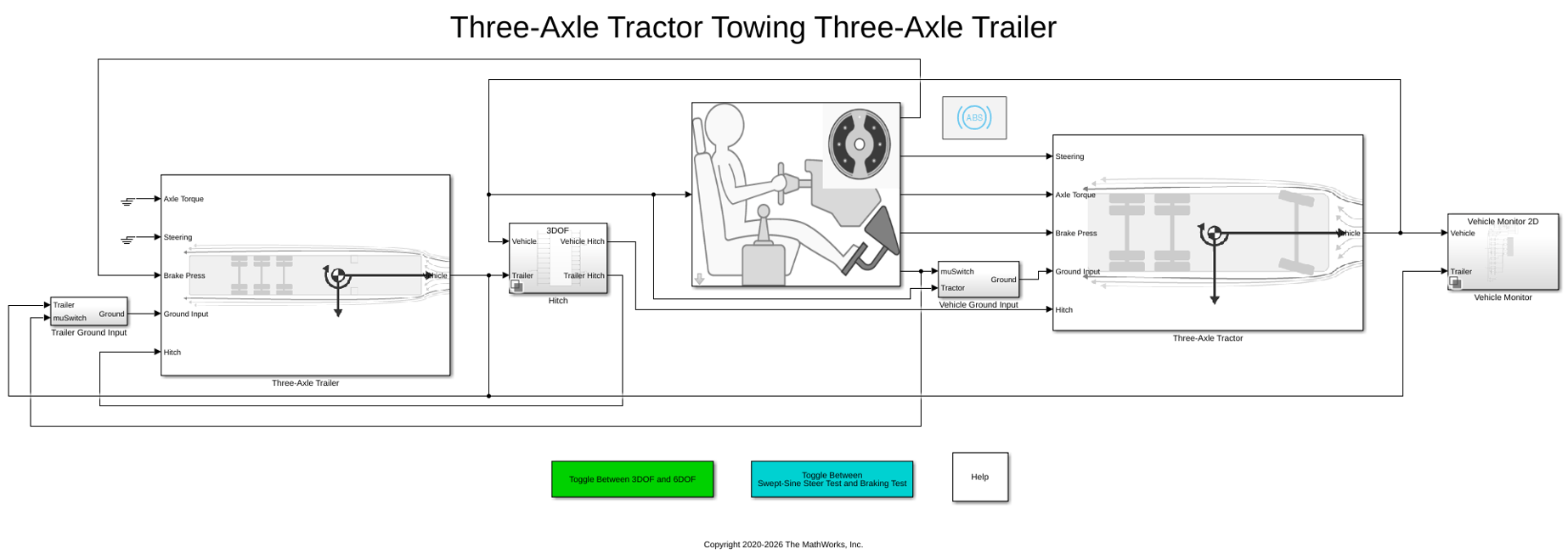
To set the block parameter value programmatically, use the set_param function.

To get the block parameter value programmatically, use the get_param function.

Parameter: dh
Values: 5 (default) | scalar
Data Types: double

Vertical distance from hitch to axle plane, hh, in m.

Dependencies

To enable this parameter, on the Input signals pane, select Rear hitch forces or Rear hitch moments.

Programmatic Use

To set the block parameter value programmatically, use the set_param function.

To get the block parameter value programmatically, use the get_param function.

Parameter: hh
Values: 0.5 (default) | scalar
Data Types: double

Initial vehicle CG displacement along the earth-fixed X-axis, in m.

Programmatic Use

To set the block parameter value programmatically, use the set_param function.

To get the block parameter value programmatically, use the get_param function.

Parameter: X_o
Values: 0 (default) | scalar
Data Types: double

Initial vehicle CG velocity along the vehicle-fixed x-axis, in m/s.

Dependencies

To enable this parameter, set Axle forces to one of these options:

  • External longitudinal forces

  • External forces

Programmatic Use

To set the block parameter value programmatically, use the set_param function.

To get the block parameter value programmatically, use the get_param function.

Parameter: xdot_o
Values: 0 (default) | scalar
Data Types: double

Lateral

Enables mapped corner stiffness calculation.

Dependencies

To enable this parameter, set Axle forces to one of these options:

  • External longitudinal velocity

  • External longitudinal forces

Programmatic Use

To set the block parameter value programmatically, use the set_param function.

To get the block parameter value programmatically, use the get_param function.

Parameter: CalphaMode
Values: off (default) | on
Data Types: character vector

Enables relaxation length dynamics.

Dependencies

To enable this parameter:

  1. Set Axle forces to one of these options:

    • External longitudinal velocity

    • External longitudinal forces

  2. Clear Mapped corner stiffness.

Programmatic Use

To set the block parameter value programmatically, use the set_param function.

To get the block parameter value programmatically, use the get_param function.

Parameter: sigmaMode
Values: on (default) | off
Data Types: character vector

Lateral distance from the geometric centerline to the center of mass, d, in m, along the vehicle-fixed y-axis. Positive values indicate that the vehicle CM is to the right of the geometric centerline. Negative values indicate that the vehicle CM is to the left of the geometric centerline.

Programmatic Use

To set the block parameter value programmatically, use the set_param function.

To get the block parameter value programmatically, use the get_param function.

Parameter: d
Values: 0 (default) | scalar
Data Types: double

Lateral distance from the geometric centerline to the hitch, hl, in m.

Dependencies

To enable this parameter, on the Input signals pane, select Rear hitch forces or Rear hitch moments.

Programmatic Use

To set the block parameter value programmatically, use the set_param function.

To get the block parameter value programmatically, use the get_param function.

Parameter: hl
Values: 0 (default) | scalar
Data Types: double

Front, middle, and rear track widths, wf, wm, and, wr, respectively, in m. Dimensions are 1-by-3.

Dependencies

To enable this parameter, set Vehicle track to Dual.

Programmatic Use

To set the block parameter value programmatically, use the set_param function.

To get the block parameter value programmatically, use the get_param function.

Parameter: w
Values: [1.8,1.8,1.8] (default) | vector
Data Types: double

Front tire corner stiffness, Cyf, in N/rad.

Dependencies

To enable this parameter:

  1. Set Axle forces to one of these options:

    • External longitudinal velocity

    • External longitudinal forces

  2. Clear Mapped corner stiffness.

Programmatic Use

To set the block parameter value programmatically, use the set_param function.

To get the block parameter value programmatically, use the get_param function.

Parameter: Cy_f
Values: 12e3 (default) | scalar
Data Types: double

Middle axle tire corner stiffness, Cym, in N/rad.

Dependencies

To enable this parameter:

  1. Set Axle forces to one of these options:

    • External longitudinal velocity

    • External longitudinal forces

  2. Clear Mapped corner stiffness.

Programmatic Use

To set the block parameter value programmatically, use the set_param function.

To get the block parameter value programmatically, use the get_param function.

Parameter: Cy_m
Values: 11e3 (default) | scalar
Data Types: double

Rear axle tire corner stiffness, Cyr, in N/rad.

Dependencies

To enable this parameter:

  1. Set Axle forces to one of these options:

    • External longitudinal velocity

    • External longitudinal forces

  2. Clear Mapped corner stiffness.

Programmatic Use

To set the block parameter value programmatically, use the set_param function.

To get the block parameter value programmatically, use the get_param function.

Parameter: Cy_r
Values: 11e3 (default) | scalar
Data Types: double

Front tire relaxation length, σf, in m.

Dependencies

To enable this parameter:

  1. Set Axle forces to one of these options:

    • External longitudinal velocity

    • External longitudinal forces

  2. Do either of these:

    • Select Mapped corner stiffness.

    • Clear Mapped corner stiffness and select Include relaxation length dynamics.

Programmatic Use

To set the block parameter value programmatically, use the set_param function.

To get the block parameter value programmatically, use the get_param function.

Parameter: sigma_f
Values: .1 (default) | scalar
Data Types: double

Middle tire relaxation length, σm, in m.

Dependencies

To enable this parameter:

  1. Set Axle forces to one of these options:

    • External longitudinal velocity

    • External longitudinal forces

  2. Do either of these:

    • Select Mapped corner stiffness.

    • Clear Mapped corner stiffness and select Include relaxation length dynamics.

Programmatic Use

To set the block parameter value programmatically, use the set_param function.

To get the block parameter value programmatically, use the get_param function.

Parameter: sigma_m
Values: .1 (default) | scalar
Data Types: double

Rear tire relaxation length, σr, in m.

Dependencies

To enable this parameter:

  1. Set Axle forces to one of these options:

    • External longitudinal velocity

    • External longitudinal forces

  2. Do either of these:

    • Select Mapped corner stiffness.

    • Clear Mapped corner stiffness and select Include relaxation length dynamics.

Programmatic Use

To set the block parameter value programmatically, use the set_param function.

To get the block parameter value programmatically, use the get_param function.

Parameter: sigma_r
Values: .1 (default) | scalar
Data Types: double

Front axle slip angle breakpoints, αfbrk, in rad.

Dependencies

To enable this parameter:

  1. Set Axle forces to one of these options:

    • External longitudinal velocity

    • External longitudinal forces

  2. Select Mapped corner stiffness.

Programmatic Use

To set the block parameter value programmatically, use the set_param function.

To get the block parameter value programmatically, use the get_param function.

Parameter: alpha_f_brk
Values: [-.1 .1] (default) | vector
Data Types: double

Front axle tire corner data, Cyfdata, in N/rad.

Dependencies

To enable this parameter:

  1. Set Axle forces to one of these options:

    • External longitudinal velocity

    • External longitudinal forces

  2. Select Mapped corner stiffness.

Programmatic Use

To set the block parameter value programmatically, use the set_param function.

To get the block parameter value programmatically, use the get_param function.

Parameter: Cy_f_data
Values: [-9e3 9e3] (default) | vector
Data Types: double

Middle axle slip angle breakpoints, αmbrk, in rad.

Dependencies

To enable this parameter:

  1. Set Axle forces to one of these options:

    • External longitudinal velocity

    • External longitudinal forces

  2. Select Mapped corner stiffness.

Programmatic Use

To set the block parameter value programmatically, use the set_param function.

To get the block parameter value programmatically, use the get_param function.

Parameter: alpha_m_brk
Values: [-.1 .1] (default) | vector
Data Types: double

Middle axle tire corner data, Cymdata, in N/rad.

Dependencies

To enable this parameter:

  1. Set Axle forces to one of these options:

    • External longitudinal velocity

    • External longitudinal forces

  2. Select Mapped corner stiffness.

Programmatic Use

To set the block parameter value programmatically, use the set_param function.

To get the block parameter value programmatically, use the get_param function.

Parameter: Cy_m_data
Values: [-9e3 9e3] (default) | vector
Data Types: double

Rear axle slip angle breakpoints, αrbrk, in rad.

Dependencies

To enable this parameter:

  1. Set Axle forces to one of these options:

    • External longitudinal velocity

    • External longitudinal forces

  2. Select Mapped corner stiffness.

Programmatic Use

To set the block parameter value programmatically, use the set_param function.

To get the block parameter value programmatically, use the get_param function.

Parameter: alpha_r_brk
Values: [-.1 .1] (default) | vector
Data Types: double

Rear axle tire corner data, Cyrdata, in N/rad.

Dependencies

To enable this parameter:

  1. Set Axle forces to one of these options:

    • External longitudinal velocity

    • External longitudinal forces

  2. Select Mapped corner stiffness.

Programmatic Use

To set the block parameter value programmatically, use the set_param function.

To get the block parameter value programmatically, use the get_param function.

Parameter: Cy_r_data
Values: [-9e3 9e3] (default) | vector
Data Types: double

Initial vehicle CG displacement along the earth-fixed Y-axis, in m.

Programmatic Use

To set the block parameter value programmatically, use the set_param function.

To get the block parameter value programmatically, use the get_param function.

Parameter: Y_o
Values: 0 (default) | scalar
Data Types: double

Initial vehicle CG velocity along the vehicle-fixed y-axis, in m/s.

Programmatic Use

To set the block parameter value programmatically, use the set_param function.

To get the block parameter value programmatically, use the get_param function.

Parameter: ydot_o
Values: 0 (default) | scalar
Data Types: double

Yaw

Yaw polar inertia, in kg*m^2.

Programmatic Use

To set the block parameter value programmatically, use the set_param function.

To get the block parameter value programmatically, use the get_param function.

Parameter: Izz
Values: 4000 (default) | scalar
Data Types: double

Rotation of the vehicle-fixed frame about earth-fixed Z-axis (yaw), in rad.

Programmatic Use

To set the block parameter value programmatically, use the set_param function.

To get the block parameter value programmatically, use the get_param function.

Parameter: psi_o
Values: 0 (default) | scalar
Data Types: double

Vehicle angular velocity about the vehicle-fixed z-axis (yaw rate), in rad/s.

Programmatic Use

To set the block parameter value programmatically, use the set_param function.

To get the block parameter value programmatically, use the get_param function.

Parameter: r_o
Values: 0 (default) | scalar
Data Types: double

Aerodynamic

Effective vehicle cross-sectional area, Af, to calculate the aerodynamic drag force on the vehicle, in m2.

Programmatic Use

To set the block parameter value programmatically, use the set_param function.

To get the block parameter value programmatically, use the get_param function.

Parameter: Af
Values: 2 (default) | scalar
Data Types: double

Air drag coefficient, Cd. The value is dimensionless.

Programmatic Use

To set the block parameter value programmatically, use the set_param function.

To get the block parameter value programmatically, use the get_param function.

Parameter: Cd
Values: .6 (default) | scalar
Data Types: double

Air lift coefficient, Cl. The value is dimensionless.

Programmatic Use

To set the block parameter value programmatically, use the set_param function.

To get the block parameter value programmatically, use the get_param function.

Parameter: Cl
Values: .1 (default) | scalar
Data Types: double

Longitudinal drag pitch moment coefficient, Cpm. The value is dimensionless.

Programmatic Use

To set the block parameter value programmatically, use the set_param function.

To get the block parameter value programmatically, use the get_param function.

Parameter: Cpm
Values: .1 (default) | scalar
Data Types: double

Relative wind angle vector, βw, in rad.

Programmatic Use

To set the block parameter value programmatically, use the set_param function.

To get the block parameter value programmatically, use the get_param function.

Parameter: beta_w
Values: [0:0.01:0.3] (default) | vector
Data Types: double

Side force coefficient vector coefficient, Cs. The value is dimensionless.

Programmatic Use

To set the block parameter value programmatically, use the set_param function.

To get the block parameter value programmatically, use the get_param function.

Parameter: Cs
Values: [0:0.03:0.9] (default) | vector
Data Types: double

Yaw moment coefficient vector, Cym. The value is dimensionless.

Programmatic Use

To set the block parameter value programmatically, use the set_param function.

To get the block parameter value programmatically, use the get_param function.

Parameter: Cym
Values: [0:0.01:0.3] (default) | vector
Data Types: double

Environment

Environmental absolute pressure, Pabs, in Pa.

Programmatic Use

To set the block parameter value programmatically, use the set_param function.

To get the block parameter value programmatically, use the get_param function.

Parameter: Pabs
Values: 101325 (default) | scalar
Data Types: double

Environmental absolute temperature, T, in K.

Dependencies

To enable this parameter, clear Air temperature.

Programmatic Use

To set the block parameter value programmatically, use the set_param function.

To get the block parameter value programmatically, use the get_param function.

Parameter: Tair
Values: 273 (default) | scalar
Data Types: double

Gravitational acceleration, g, in m/s^2.

Programmatic Use

To set the block parameter value programmatically, use the set_param function.

To get the block parameter value programmatically, use the get_param function.

Parameter: g
Values: 9.81 (default) | scalar
Data Types: double

Nominal friction scale factor, μ. The value is dimensionless.

Dependencies

To enable this parameter:

  1. Set Axle forces to one of these options:

    • External longitudinal velocity

    • External longitudinal forces

  2. Clear External Friction.

Programmatic Use

To set the block parameter value programmatically, use the set_param function.

To get the block parameter value programmatically, use the get_param function.

Parameter: mu
Values: 1 (default) | scalar
Data Types: double

Simulation

Longitudinal velocity tolerance, in m/s.

Programmatic Use

To set the block parameter value programmatically, use the set_param function.

To get the block parameter value programmatically, use the get_param function.

Parameter: xdot_tol
Values: .01 (default) | scalar
Data Types: double

Nominal normal force, in N.

Dependencies

To enable this parameter, set Axle forces to one of these options:

  • External longitudinal velocity

  • External longitudinal forces

Programmatic Use

To set the block parameter value programmatically, use the set_param function.

To get the block parameter value programmatically, use the get_param function.

Parameter: Fznom
Values: 5000 (default) | scalar
Data Types: double

Vehicle chassis offset from the axle plane along the vehicle-fixed x-axis, in m. When using the 3D visualization engine, use the offset to locate the chassis relative to the vehicle’s CG to ensure alignment with the mesh origin relative to the CG. You can also use it to report position and velocity information at any defined location.

Programmatic Use

To set the block parameter value programmatically, use the set_param function.

To get the block parameter value programmatically, use the get_param function.

Parameter: longOff
Values: 0 (default) | scalar
Data Types: double

Vehicle chassis offset from the center plane along the vehicle-fixed y-axis, in m. When using the 3D visualization engine, use the offset to locate the chassis relative to the vehicle’s CG to ensure alignment with the mesh origin relative to the CG. You can also use it to report position and velocity information at any defined location.

Programmatic Use

To set the block parameter value programmatically, use the set_param function.

To get the block parameter value programmatically, use the get_param function.

Parameter: latOff
Values: 0 (default) | scalar
Data Types: double

Vehicle chassis offset from the axle plane along the vehicle-fixed z-axis, in m. When using the 3D visualization engine, use the offset to locate the chassis relative to the vehicle’s CG to ensure alignment with the mesh origin relative to the CG. You can also use it to report position and velocity information at any defined location.

Programmatic Use

To set the block parameter value programmatically, use the set_param function.

To get the block parameter value programmatically, use the get_param function.

Parameter: vertOff
Values: 0 (default) | scalar
Data Types: double

Wrap the Euler angles to the interval [-pi, pi]. For vehicle maneuvers that might undergo vehicle yaw rotations that are outside of this interval, consider clearing the parameter if you want to:

  • Track the total vehicle yaw rotation.

  • Avoid discontinuities in the vehicle state estimators.

Programmatic Use

To set the block parameter value programmatically, use the set_param function.

To get the block parameter value programmatically, use the get_param function.

Parameter: wrapAng
Values: off (default) | on
Data Types: character vector

References

[1] Gillespie, Thomas. Fundamentals of Vehicle Dynamics. Warrendale, PA: Society of Automotive Engineers (SAE), 1992.

Extended Capabilities

expand all

C/C++ Code Generation
Generate C and C++ code using Simulink® Coder™.

Version History

Introduced in R2020a