Contenuto principale

azelaxes

Spherical basis vectors in 3-by-3 matrix form

Description

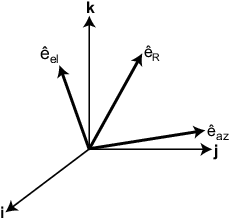
A = azelaxes(az,el) returns a 3-by-3 matrix containing the components of the basis(e^R,e^az,e^el) at each point on the unit sphere specified by azimuth, az, and elevation, el. The columns of A contain the components of basis vectors in the order of radial, azimuthal and elevation directions.

example

Examples

collapse all

At the point located at 45° azimuth, 45° elevation, compute the 3-by-3 matrix containing the components of the spherical basis.

A = azelaxes(45,45)
A = 3×3

    0.5000   -0.7071   -0.5000
    0.5000    0.7071   -0.5000
    0.7071         0    0.7071

The first column of A contains the radial basis vector [0.5000; 0.5000; 0.7071]. The second and third columns are the azimuth and elevation basis vectors, respectively.

Input Arguments

collapse all

Azimuth angle, specified as a scalar or real-valued M-by-1 vector in the closed range [–180,180]. M is the number of azimuth angles and must match the size of el. To define the azimuth angle of a point on a sphere, construct a vector from the origin to the point. The azimuth angle is the angle in the xy-plane from the positive x-axis to the vector's orthogonal projection into the xy-plane. As examples, 0° azimuth angle and 0° elevation angle specify a point on the x-axis while an azimuth angle of –90° and an elevation angle of 0° specify a point on the y-axis. Angle units are in degrees.

Example: [10,45]

Data Types: single | double

Elevation angle specified as a scalar or real-valued M-by-1 vector in the closed range [–90,90]. M is the number of elevation angles and must match the size of az. To define the elevation angle of a point on the sphere, construct a vector from the origin to the point. The elevation angle is the angle from vector's orthogonal projection into the xy-plane to the vector itself. As examples, 0° elevation angle defines the equator of the sphere and ±90° elevation define the north and south poles, respectively. Angle units are in degrees.

Example: [2,-3]

Data Types: single | double

Output Arguments

collapse all

Spherical basis vectors returned as a 3-by-3 matrix. The columns contain the unit vectors in the radial, azimuthal, and elevation directions, respectively. Symbolically we can write the matrix as

(e^R,e^az,e^el)

where each component represents a column vector.

More About

collapse all

Algorithms

MATLAB® computes the matrix A from the equations

A = [cosd(el)*cosd(az), -sind(az), -sind(el)*cosd(az); ...
		cosd(el)*sind(az),  cosd(az), -sind(el)*sind(az); ...
		sind(el),           0,         cosd(el)];

Extended Capabilities

expand all

Version History

Introduced in R2013a