pcfitcuboid
R2026bFit cuboid to 3-D point cloud
Description
Examples
Load the point cloud data into the workspace.
ptCloud = load("drivingLidarPoints.mat").ptCloud;Select a region of interest for cuboid fitting.
roi = [-10 10 -6 8 -2 2];
idx = findPointsInROI(ptCloud,roi);
ptCloudROI = select(ptCloud,idx);
Visualize the cropped point cloud.
figure
pcshow(ptCloudROI)
title("Cropped Point Cloud")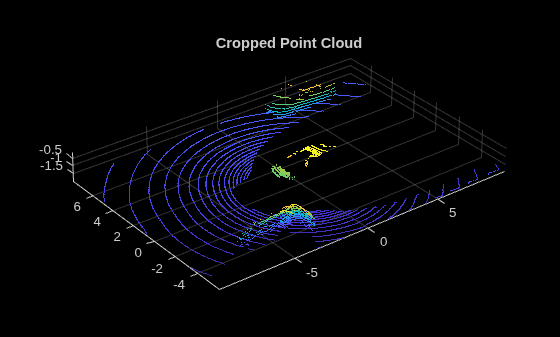
Segment the ground plane.
maxDistance = 0.5;
[~,idxGround,idxNoGround] = pcfitplane(ptCloudROI,maxDistance);
groundPtCloud = select(ptCloudROI,idxGround);
ptCloudNoGround = select(ptCloudROI,idxNoGround);
Visualize the segmented ground plane.
figure
pcshowpair(groundPtCloud,ptCloudNoGround)
legend("Ground Point Cloud","Non-Ground Point Cloud")
title("Segmented Ground Plane")
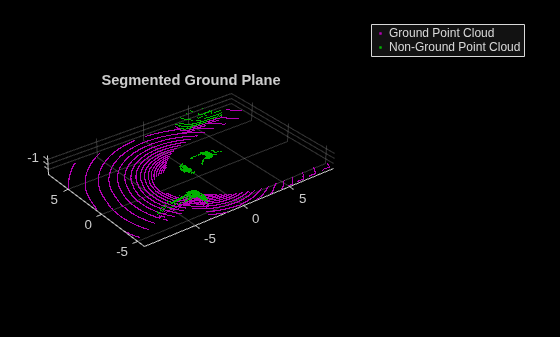
Segment the non-ground point cloud into clusters.
minDistance = 1;
[labels,numClusters] = pcsegdist(ptCloudNoGround,minDistance);
Visualize the point cloud and each cluster in a different color.
figure
pcshow(ptCloudROI)
hold on
pcshow(ptCloudNoGround.Location,labels)
Fit a cuboid to each cluster, and visualize each cluster with its respective fitted cuboid.
for i = 1:numClusters
    idx = find(labels == i);
    model = pcfitcuboid(ptCloudNoGround,idx);
    plot(model)
end
title("Clustered Point Cloud with Fitted Cuboids")
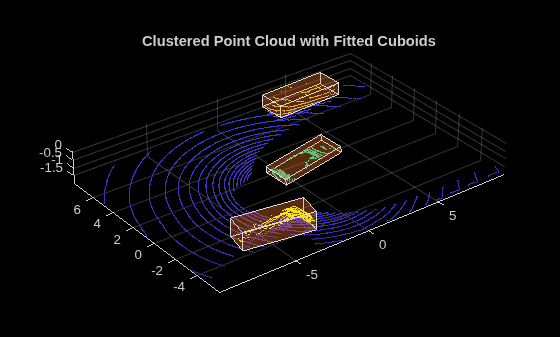
Input Arguments
Output Arguments
Algorithms
This algorithm uses the convex hull of the points in the input point cloud to compute an oriented bounding cuboid. The algorithm performs these steps:
Compute the convex hull of the 3-D points.
For each face of the convex hull, compute a candidate cuboid with one face coplanar with the convex hull face.
Select the candidate cuboid with the smallest volume.
When the convex hull contains only a small number of faces, the orientation of the true minimum-volume cuboid might not align with any convex hull face. Because the algorithm considers only orientations derived from convex hull faces, it can return a suboptimal bounding cuboid. For example, four non-coplanar points form a tetrahedral convex hull with only four faces, and the optimal cuboid orientation might not align with any of them.

