Rod
R2026bAxially flexible bar or cable
Rod block
To add a block to a model, double-click the canvas and start typing the block name. Then, select the block from the list.
Libraries:
Simscape /
Driveline /
Couplings & Drives
Description
The Rod block represents an axially flexible bar or cable in tension or compression.
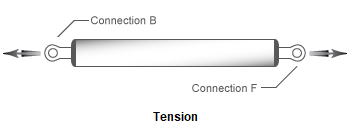
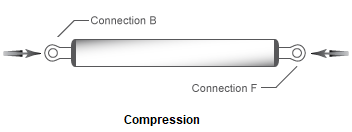
To represent the bar or cable, the block uses a lumped parameter model, where
N is the value of the Number of flexible
elements parameter. The block uses N spring and
damper sets to connect N+1 lumped masses in series. The spring
represents elasticity. The damper represents material damping. The figure demonstrates
an equivalent network to the Rod block with the
Number of flexible elements parameter set to
3.
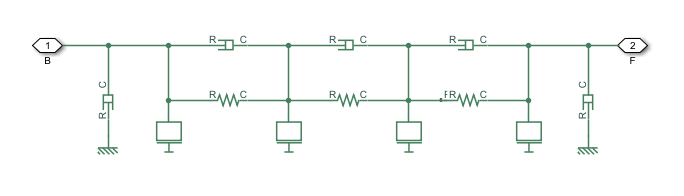
When you set Parameterization to By stiffness and
inertia or By material and geometry, the
block evenly distributes the total mass of the rod over the mass blocks. The stiffness
of the spring in each spring and damper circuit is equal to N times
the stiffness of the rod material.
When you set Parameterization to By segment stiffness
and inertia or By material and segment
geometry, you define each segment by its individual properties. The
block distributes the N flexible elements uniformly along the total
rod length and interpolates the segment properties across the elements. The length of
the vector parameters determines the number of segments.
Equations
The defining equations for the model are
where:
η is the damping of the rod.
ς is the damping ratio of the rod material.
K is the stiffness of the rod.
A is the cross-sectional area of the rod.
D is the outer diameter of the rod.
d is the inner diameter of the rod, where
d = 0 for a solid rod.
d > 0 for an annular, or hollow, rod.
E is the Young's modulus, or the modulus of elasticity, of the rod material.
L is the length of the rod.
m is the mass of the rod.
ρ is the density of the rod material.
When you set Parameterization to By segment stiffness
and inertia or By material and segment
geometry, the block defines the mass, stiffness, and damping
coefficient for each flexible element. xj
is the location of the jth node, where j ∈ [1, 2, 3, …
N+1]. The block distributes the nodes uniformly along the rod length,
and assigns the mass to each flexible element, such that
where, i ∈ [1, 2, 3, … N]. The block assigns the stiffness of the spring in each flexible element, such that
The damping coefficient in each flexible element is
In each segment, the block treats
ρ(x),
E(x), and
A(x) as uniform and interpolates the
segment properties across elements by using the tablelookup
function.
The mass assigned to each nodal point is
For the nodes at the two ends of the rod,
Assumptions and Limitations
Cables do not go slack.
Bars do not buckle.
When you set Parameterization to
By segment stiffness and inertiaorBy material and segment geometry, the block treats the material properties and cross-sectional geometry in each segment as uniform.The block does not support combinations of varying material properties and varying segment geometry.
Ports
Conserving
Parameters
Extended Capabilities
Version History
Introduced in R2018bSee Also
Flexible Shaft | Mass | Translational Damper | Translational Spring

