meijerG
R2026bMeijer G-function
Syntax
Description
Examples
syms x
meijerG(3, [], [], 2, 5)
ans =
    25
Call meijerG when z is an array.
meijerG acts element-wise.
a = 2;
z = [1 2 3];
meijerG(a, [], [], [], z)
ans =
0.3679 1.2131 2.1496Convert numeric input to symbolic form using
sym, and find the Meijer G-function. For certain
symbolic inputs, meijerG returns exact symbolic output
using other functions.
meijerG(sym(2), [], [], [], sym(3))
ans =
3*exp(-1/3)
meijerG(sym(2/5), [], sym(1/2), [], sym(3))
ans =
(2^(4/5)*3^(1/2)*gamma(1/10))/80
For symbolic variables or expressions,
meijerG returns an output in terms of simple or special
functions.
syms a b c d z
f = meijerG(a,b,c,d,z)
f =
(gamma(c - a + 1)*(1/z)^(1 - a)*hypergeom([c - a + 1, d - a + 1],...
 b - a + 1, 1/z))/(gamma(b - a + 1)*gamma(a - d))
Substitute values for the variables by using subs,
and convert values to double by using double.
fVal = subs(f, [a b c d z], [1.2 3 5 7 9])
fVal =
(266*9^(1/5)*hypergeom([24/5, 34/5], 14/5, 1/9))/(25*gamma(-29/5))
double(fVal)
ans =
   5.7586e+03
Calculate fVal to higher precision using
vpa.
vpa(fVal)
ans =
5758.5946416377834597597497022199
Show relations between meijerG and
simpler functions for given parameter values.
Show that when a, b, and
d are empty, and c = 0, then
meijerG reduces to
exp(-z).
syms z
meijerG([], [], 0, [], z)
ans =
exp(-z)
Show that when a, b, and
d are empty, and c = [1/2
-1/2], then meijerG reduces to 2Kv(1,2z1/2).
meijerG([], [], [1/2 -1/2], [], z)
ans =
2*besselk(1, 2*z^(1/2))
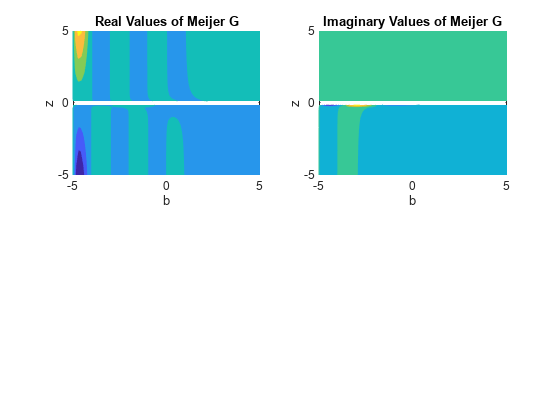
Plot the real and imaginary values of the Meijer G-function for values of b and z, where a = [-2 2] and c and d are empty. Fill the contours by setting Fill to on.
syms b z
f = meijerG([-2 2], b, [], [], z);

subplot(2,2,1)
fcontour(real(f),'Fill','on')
title('Real Values of Meijer G')
xlabel('b')
ylabel('z')

subplot(2,2,2)
fcontour(imag(f),'Fill','on')
title('Imaginary Values of Meijer G')
xlabel('b')
ylabel('z')
Input Arguments
More About
Algorithms
For the Meijer G-function
meijerG([a1,…,an],
                        [an + 1,…,ap],
                        [b1,…,bm], [bm +
1,…,bq], z), for ai ∊
(a1,…,an) and bj ∊
(b1,…,bm), no pair of parameters ai − bj should differ by a positive integer.
The Meijer G-function involves a complex contour integral with one of the following types of integration paths:
The contour goes from - i ∞ to i ∞ so that all poles of , j = 1, …, m lie to the right of the path, and all poles of , k = 1, …, n lie to the left of the path. The integral converges if , |arg(z)| < c π. If |arg(z)| = c π, c ≥ 0, the integral converges absolutely when p = q and ℜ(ψ) < - 1, where . When p ≠ q, the integral converges if you choose the contour so that the contour points near i ∞ and - i ∞ have a real part σ satisfying .
The contour is a loop beginning and ending at ∞ and encircling all poles of , j = 1, …, m moving in the negative direction, but none of the poles of , k = 1, …, n. The integral converges if q ≥ 1 and either p < q or p = q and |z| < 1.
The contour is a loop beginning and ending at - ∞ and encircling all poles of , k = 1, …, n moving in the positive direction, but none of the poles of , j = 1, …, m. The integral converges if p ≥ 1 and either p > q or p = q and |z| > 1.
The integral represents an inverse Laplace transform or, more specifically, a Mellin-Barnes type of integral.
For a given set of parameters, the contour chosen in the definition of the Meijer G-function is the one for which the integral converges. If the integral converges for several contours, all contours lead to the same function.
The Meijer G-function satisfies a differential equation of order max(p, q) with respect to a variable z:
If p < q, this differential equation has a regular singularity at z = 0 and an irregular singularity at z = ∞. If p = q, the points z = 0 and z = ∞ are regular singularities, and there is an additional regular singularity at z = (−1)m + n - p.
The Meijer G-function represents an analytic continuation of the hypergeometric function [1]. For particular choices of parameters, you can express the Meijer G-function through the hypergeometric function. For example, if no two of the bh terms, h = 1, …, m, differ by an integer or zero and all poles are simple, then
Here p < q or p = q and |z| < 1. Ah denotes
Bh denotes
Meijer G-functions with different parameters can represent the same function.
The Meijer G-function is symmetric with respect to the parameters. Changing the order inside each of the following lists of vectors does not change the resulting Meijer G-function: [a1, …, an], [an + 1, …, ap], [b1, …, bm], [bm + 1, …, bq].
If z is not a negative real number and z ≠ 0, the function satisfies the following identity:
.
If 0 < n < p and r = a1 - ap is an integer, the function satisfies the following identity:
.
If 0 < m < q and r = b1 - bq is an integer, the function satisfies the following identity:
.
According to these rules, the meijerG function call can return
meijerG with modified input parameters.
References
[1] Luke, Y. L., The Special Functions and Their Approximations. Vol. 1. New York: Academic Press, 1969.
[2] Prudnikov, A. P., Yu. A. Brychkov, and O. I. Marichev, Integrals and Series. Vol 3: More Special Functions. Gordon and Breach, 1990.
[3] Abramowitz, M., I. A. Stegun, Handbook of Mathematical Functions. 9th printing. New York: Dover Publications, 1970.
Version History
Introduced in R2017b

