imlpt
R2026bInverse multiscale local 1-D polynomial transform
Description
y = imlpt(coefs,T,coefsPerLevel,scalingMoments)coefs.
The inputs to imlpt must be the outputs of mlpt.
Examples
Create a signal with nonuniform sampling and verify good reconstruction.
Create and plot a sine wave with nonuniform sampling.
timeVector = 0:0.01:1;
sineWave = sin(2*pi*timeVector);

samplesToErase = randi(100,1,100);
sineWave(samplesToErase) = [];
timeVector(samplesToErase) = [];

plot(timeVector,sineWave,"o")
grid on
title("Signal")
xlabel("Time (s)")
ylabel("Amplitude")
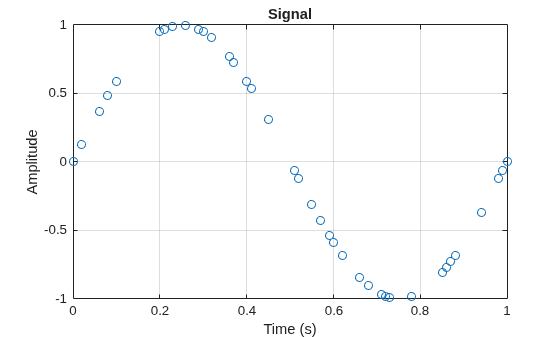
Use mlpt to obtain the multiscale local 1-D polynomial transform of the signal. Visualize the coefficients.
[coefs,T,coefsPerLevel,scalingMoments] = mlpt(sineWave,timeVector);
stem(coefs)
grid on
title("Wavelet Coefficients")
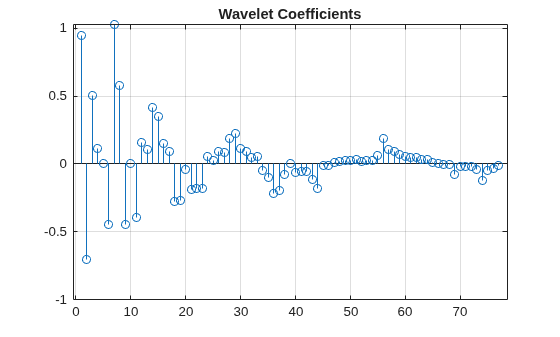
Use imlpt to obtain the inverse multiscale local 1-D polynomial transform of the coefficients. Plot the original signal and the reconstruction.
y = imlpt(coefs,T,coefsPerLevel,scalingMoments);

plot(timeVector,sineWave,"o")
hold on
plot(T,y,"x")
hold off
grid on
legend("Original Signal","Reconstruction")
xlabel("Time (s)")
ylabel("Amplitude")
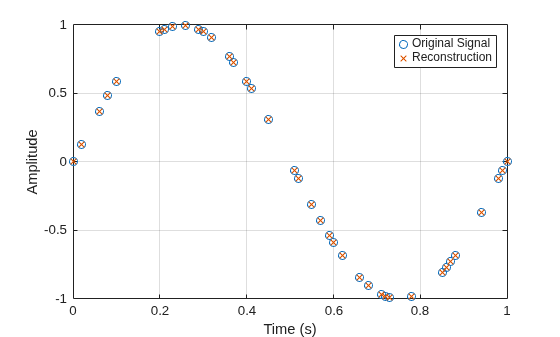
Inspect the total error to verify good reconstruction.
reconstructionError = sum(abs(y'-sineWave))
reconstructionError =
3.0396e-15
Specify nondefault dual moments by using the mlpt function. Compare the results of analysis and synthesis using the default and nondefault dual moments.
Create an input signal and visualize it.
t = linspace(0,1,200)';
x = cos(10*pi*t.^2);
plot(t,x)
title("Signal")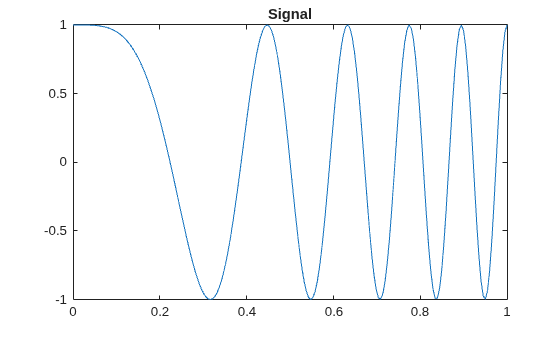
By default, DualMoments, the number of dual vanishing moments, is 2. Perform the forward and inverse transform for the input signal twice, with DualMoments set to 2 and 3.
[w2,t2,nj2,scalingmoments2] = mlpt(x,t);
y2 = imlpt(w2,t2,nj2,scalingmoments2);

[w3,t3,nj3,scalingmoments3] = mlpt(x,t,DualMoments=3);
y3 = imlpt(w3,t3,nj3,scalingmoments3,DualMoments=3);
Plot both reconstructions.
plot(t,x)
hold on
plot(t2,y2,'o')
plot(t3,y3,'*')
hold off
legend("Original", ...
       "DualMoments = 2", ...
       "DualMoments = 3");
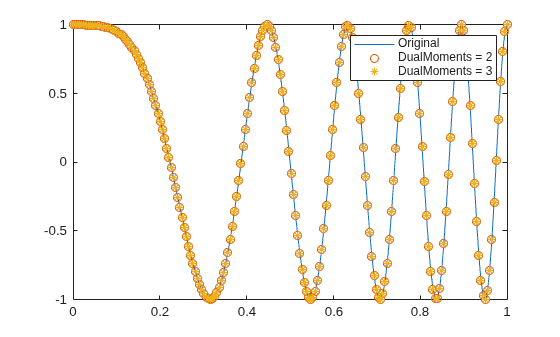
For each reconstruction, compute the mean error. Verify perfect reconstruction.
fprintf("Mean Error\nDualMoments = 2: %e\nDualMoments = 3: %e", ...
    mean(abs(y2-x)),mean(abs(y3-x)))
Mean Error
DualMoments = 2: 6.852158e-17
DualMoments = 3: 5.880713e-17
Input Arguments
Output Arguments
Algorithms
Maarten Jansen developed the theoretical foundation of the multiscale
local polynomial transform (MLPT) and algorithms for its efficient
computation [1][2][3]. The MLPT uses a lifting scheme, wherein a kernel
function smooths fine-scale coefficients with a given bandwidth to
obtain the coarser resolution coefficients. The mlpt function uses only local polynomial
interpolation, but the technique developed by Jansen is more general
and admits many other kernel types with adjustable bandwidths [2].
References
[1] Jansen, Maarten. “Multiscale Local Polynomial Smoothing in a Lifted Pyramid for Non-Equispaced Data.” IEEE Transactions on Signal Processing 61, no. 3 (February 2013): 545–55. https://doi.org/10.1109/TSP.2012.2225059.
[2] Jansen, Maarten, and Mohamed Amghar. “Multiscale Local Polynomial Decompositions Using Bandwidths as Scales.” Statistics and Computing 27, no. 5 (September 2017): 1383–99. https://doi.org/10.1007/s11222-016-9692-8.
[3] Jansen, Maarten, and Patrick Oonincx. Second Generation Wavelets and Applications. London ; New York: Springer, 2005.

