Modify surrogateopt Options
R2026bThis example shows how to search for a global minimum by running surrogateopt on a two-dimensional problem that has six local minima. The example then shows how to modify some options to search more effectively.
Define the objective function sixmin as follows.
sixmin = @(x)(4*x(:,1).^2 - 2.1*x(:,1).^4 + x(:,1).^6/3 ...
    + x(:,1).*x(:,2) - 4*x(:,2).^2 + 4*x(:,2).^4);
Plot the function.
[X,Y] = meshgrid(linspace(-2.1,2.1),linspace(-1.2,1.2));
Z = sixmin([X(:),Y(:)]);
Z = reshape(Z,size(X));
surf(X,Y,Z,EdgeColor="none")
view(-139,31)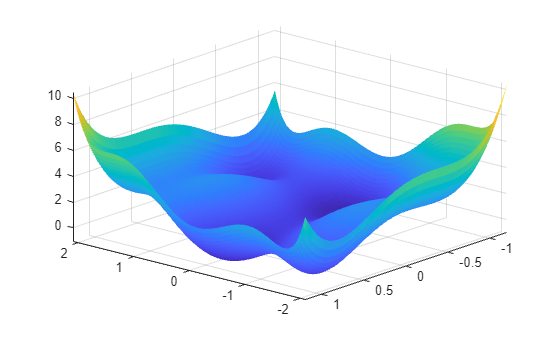
The function has six local minima and two global minima.
Run surrogateopt on the problem using the "surrogateoptplot" plot function in the region bounded in each direction by [-2.1,2.1]. To understand the "surrogateoptplot" plot, see Interpret surrogateoptplot.
rng default
lb = [-2.1,-2.1];
ub = -lb;
opts = optimoptions("surrogateopt",PlotFcn="surrogateoptplot");
[xs,fvals,eflags,outputs] = surrogateopt(sixmin,lb,ub,opts);
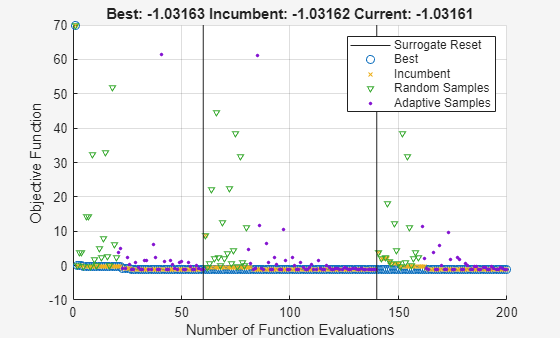
surrogateopt stopped because it exceeded the function evaluation limit set by
'options.MaxFunctionEvaluations'.
Set a smaller value for the MinSurrogatePoints option to see whether the change helps the solver reach the global minimum faster.
opts.MinSurrogatePoints = 4;
[xs2,fvals2,eflags2,outputs2] = surrogateopt(sixmin,lb,ub,opts);
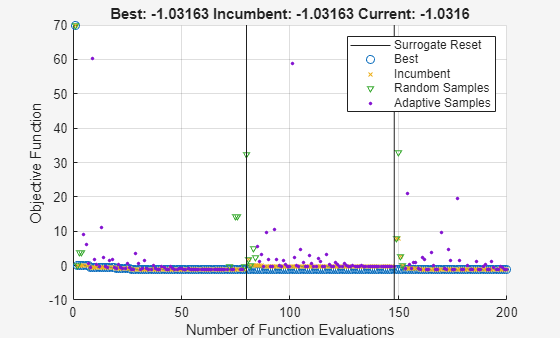
surrogateopt stopped because it exceeded the function evaluation limit set by
'options.MaxFunctionEvaluations'.
The smaller MinSurrogatePoints option does not noticeably change the solver behavior.
Try setting a larger value of the MinSampleDistance option.
opts.MinSampleDistance = 0.05;
[xs3,fvals3,eflags3,outputs3] = surrogateopt(sixmin,lb,ub,opts);
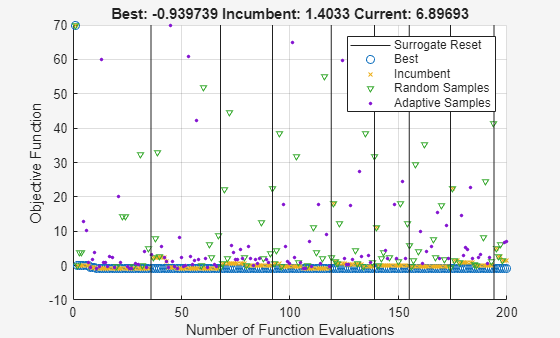
surrogateopt stopped because it exceeded the function evaluation limit set by
'options.MaxFunctionEvaluations'.
Changing the MinSampleDistance option has a small effect on the solver. This setting causes the surrogate to reset more often, and causes the best objective function to be slightly higher (worse) than before.
Try using parallel processing. Time the execution both with and without parallel processing on the camelback function, which is a variant of the sixmin function. To simulate a time-consuming function, the camelback function has an added pause of one second for each function evaluation.
function y = camelback(x)

y = (4*x(1)^2 - 2.1*x(1)^4 + x(1)^6/3 ...
    + x(1)*x(2) - 4*x(2)^2 + 4*x(2)^4);
pause(1)
end
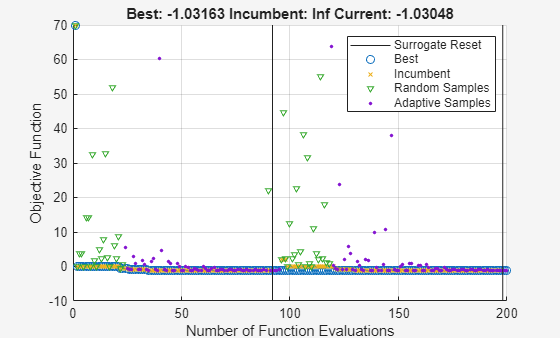
Run the solver, and return the solution time.
opts = optimoptions("surrogateopt",UseParallel=true,PlotFcn="surrogateoptplot");
tic
[xs4,fvals4,eflags4,outputs4] = surrogateopt(@camelback,lb,ub,opts);
surrogateopt stopped because it exceeded the function evaluation limit set by
'options.MaxFunctionEvaluations'.
toc
Elapsed time is 58.567754 seconds.
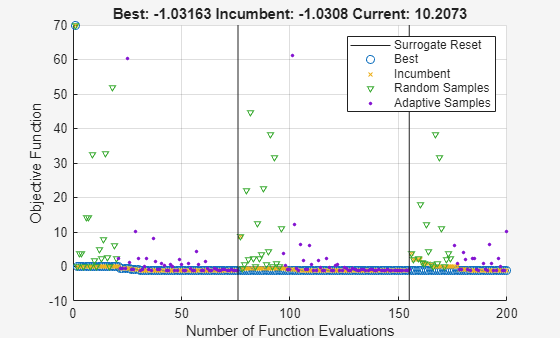
Time the solver when run on the same problem in serial.
opts.UseParallel = false;
tic
[xs5,fvals5,eflags5,outputs5] = surrogateopt(@camelback,lb,ub,opts);
surrogateopt stopped because it exceeded the function evaluation limit set by
'options.MaxFunctionEvaluations'.
toc
Elapsed time is 221.516376 seconds.
For time-consuming objective functions, parallel processing significantly improves the speed, without overly affecting the results.

