Contenuto principale

deconvwnr

Deblur image using Wiener filter

Description

J = deconvwnr(I,psf,nsr) deconvolves image I using the Wiener filter algorithm, returning deblurred image J. psf is the point-spread function (PSF) with which I was convolved. nsr is the noise-to-signal power ratio of the additive noise. The algorithm is optimal in a sense of least mean squared error between the estimated and the true images.

example

J = deconvwnr(I,psf,ncorr,icorr) deconvolves image I, where ncorr is the autocorrelation function of the noise and icorr is the autocorrelation function of the original image.

J = deconvwnr(I,psf) deconvolves image I using the Wiener filter algorithm with no estimated noise. In the absence of noise, a Wiener filter is equivalent to an ideal inverse filter.

Examples

collapse all

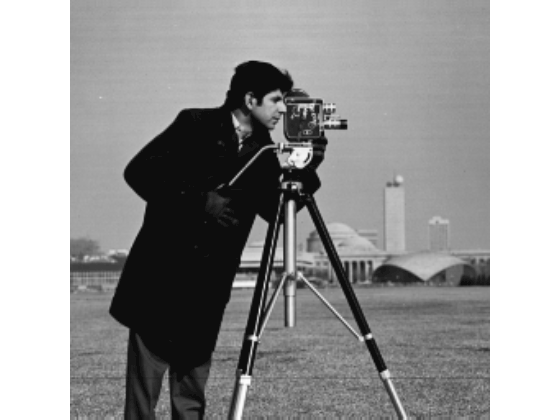
Read an image into the workspace and display it.

im = imread("cameraman.tif");
imageshow(im)
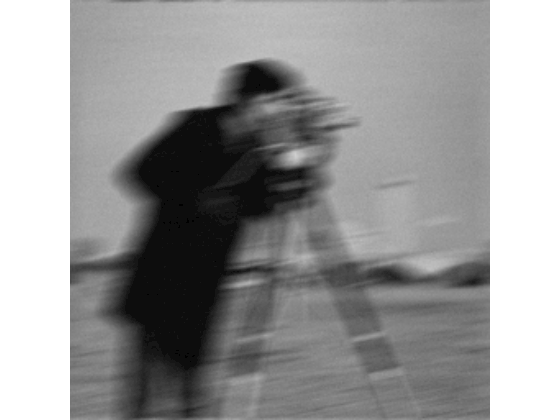
Simulate a blurred image that might result from camera motion. First, create a point-spread function, PSF, by using the fspecial function and specifying linear motion across 21 pixels at an angle of 11 degrees. Then, convolve the point-spread function with the image by using imfilter. To reduce quantization errors, convert the image to double before calling imfilter.

len = 21;
theta = 11;
PSF = fspecial("motion",len,theta);
im = im2double(im);
imBlurred = imfilter(im,PSF,"conv","circular");

Add simulated Gaussian noise to the blurred image.

noise_mean = 0;
noise_var = 0.0001;
imBlurredNoisy = imnoise(imBlurred,"gaussian",noise_mean,noise_var);

Display the blurred and noisy image.

imageshow(imBlurredNoisy)
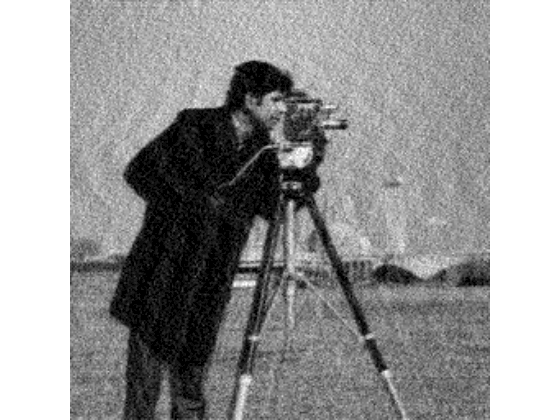
Restore the image using an estimate of the noise-to-signal-power ratio.

estimated_nsr = noise_var / var(imBlurredNoisy(:));
wnr3 = deconvwnr(imBlurredNoisy,PSF,estimated_nsr);
imageshow(wnr3)
Input Arguments

collapse all

Blurry image, specified as a numeric array of any dimension.

Data Types: single | double | int16 | uint8 | uint16

Point-spread function, specified as a numeric array. The dimensionality of psf must be less than or equal to the dimensionality of I. The size of psf must be less than or equal to the size of I in each dimension.

Data Types: double

Noise-to-signal ratio, specified as a nonnegative scalar or numeric array of the same size as the image, I. If nsr is an array, then it represents the spectral domain. Specifying 0 for the nsr is equivalent to creating an ideal inverse filter.

Data Types: double

Autocorrelation function of the noise, specified as a numeric array of any size or dimension, not exceeding the original image.

  • If the dimensionality of ncorr matches the dimensionality of the image I, then the values correspond to the autocorrelation within each dimension.

  • If ncorr is a vector and psf is also a vector, then the values in ncorr represent the autocorrelation function in the first dimension.

  • If ncorr is a vector and psf is an array, then the 1-D autocorrelation function is extrapolated by symmetry to all non-singleton dimensions of psf.

  • If ncorr is a scalar, then the value represents the power of the noise.

Data Types: double

Autocorrelation function of the image, specified as a numeric array of any size or dimension, not exceeding the original image.

  • If the dimensionality of icorr matches the dimensionality of the image I, then the values correspond to the autocorrelation within each dimension.

  • If icorr is a vector and psf is also a vector, then the values in icorr represent the autocorrelation function in the first dimension.

  • If icorr is a vector and psf is an array, then the 1-D autocorrelation function is extrapolated by symmetry to all non-singleton dimensions of psf.

  • If icorr is a scalar, then the value represents the power of the image.

Data Types: double

Output Arguments

collapse all

Deblurred image, returned as a numeric array. J has the same data type as I.

Tips

  • The output image J could exhibit ringing introduced by the discrete Fourier transform used in the algorithm. To reduce the ringing, use I = edgetaper(I,psf) before calling deconvwnr.

References

[1] Gonzalez, R. C., and R. E. Woods. Digital Image Processing. Addison-Wesley Publishing Company, Inc., 1992.

Version History

Introduced before R2006a