Filtri adattivi
R2026aDSP System Toolbox™ offre diverse varianti degli algoritmi dei filtri adattivi a risposta impulsiva finita (FIR) LMS e RLS. Sebbene questi algoritmi differiscano nei dettagli, condividono un approccio operativo comune, che consiste nel minimizzare la differenza di errore tra l'output del filtro adattivo e il segnale desiderato. L'errore quadratico medio (MSE) è la metrica più comunemente utilizzata per quantificare questo errore. I filtri adattivi trovano ampio impiego in numerose applicazioni, tra cui la cancellazione del rumore acustico, la cancellazione dell'eco, la formazione del fascio, l'identificazione dei sistemi, il miglioramento dei segnali biomedici, l'equalizzazione dei canali di comunicazione, ecc. Per alcuni esempi che illustrano alcune di queste applicazioni, vedere System Identification of FIR Filter Using LMS Algorithm, Noise Cancellation Using Sign-Data LMS Algorithm e Inverse System Identification Using RLS Algorithm.
Quando gli input sono colorati, gli algoritmi dei filtri adattivi a proiezione affine offerti dall'oggetto dsp.AffineProjectionFilter migliorano notevolmente la velocità di convergenza rispetto alle varianti LMS. Pur comportando un maggiore costo computazionale, l'algoritmo del filtro a reticolo adattivo offerto dall'oggetto dsp.AdaptiveLatticeFilter può fornire una convergenza migliore rispetto alle controparti LMS e RLS. È inoltre possibile implementare un filtro FIR adattivo nel dominio della frequenza utilizzando l'oggetto dsp.FrequencyDomainAdaptiveFilter.
La prestazione della convergenza è determinata dalla traiettoria dell'MSE effettivo, definita da msesim e dal modo in cui converge con l'MSE previsto, definito da msepred.
Oggetti
dsp.BlockLMSFilter | Compute output, error, and weights using block least mean squares (LMS) adaptive algorithm |
dsp.LMSFilter | Compute output, error, and weights of least mean squares (LMS) adaptive filter |
dsp.RLSFilter | Compute output, error and coefficients using recursive least squares (RLS) algorithm |
dsp.AffineProjectionFilter | Compute output, error and coefficients using affine projection (AP) Algorithm |
dsp.AdaptiveLatticeFilter | Adaptive lattice filter |
dsp.FastTransversalFilter | Fast transversal least-squares FIR adaptive filter |
dsp.FilteredXLMSFilter | Filtered XLMS filter |
dsp.FrequencyDomainAdaptiveFilter | Compute output, error, and coefficients using frequency-domain FIR adaptive filter |
Blocchi
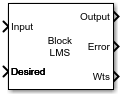 | Block LMS Filter | Compute output, error, and weights using LMS adaptive algorithm |
 | Fast Block LMS Filter | Compute output, error, and weights using least mean squares (LMS) adaptive algorithm |
 | Frequency-Domain Adaptive Filter | Compute output, error, and coefficients using frequency domain FIR adaptive filter |
 | Kalman Filter | Predict or estimate states of dynamic systems |
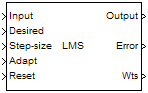 | LMS Filter | Compute output, error, and weights using least mean squares (LMS) adaptive algorithm |
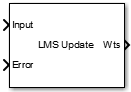 | LMS Update | Estimate weights of least mean squares (LMS) adaptive filter |
 | RLS Filter | Compute filtered output, filter error, and filter weights for given input and desired signal using RLS adaptive filter algorithm |
Argomenti
- Overview of Adaptive Filters and Applications
General discussion on how adaptive filters work, list of adaptive filter algorithms in DSP System Toolbox, convergence performance, and details on few common applications.
- System Identification of FIR Filter Using LMS Algorithm
Identify an unknown system using LMS algorithm.
- System Identification of FIR Filter Using Normalized LMS Algorithm
Identify an unknown system using normalized LMS algorithm.
- Compare Convergence Performance Between LMS Algorithm and Normalized LMS Algorithm
Compare the speed with which the adaptive filter algorithms converge.
- Signal Enhancement Using LMS and NLMS Algorithms
Introduces adaptive filters through a signal enhancement application.
- Noise Cancellation Using Sign-Data LMS Algorithm
Perform noise cancellation using sign-data LMS algorithm.
- System Identification Using RLS Adaptive Filtering
This example shows how to use a recursive least-squares (RLS) filter to identify an unknown system modeled with a lowpass FIR filter.
- Inverse System Identification Using RLS Algorithm
Perform inverse system identification using dsp.RLSFilter.
- Compare RLS and LMS Adaptive Filter Algorithms
Comparison of RLS and LMS adaptive filter algorithms.
- Adapt Multiple Filters Using LMS Update Block
Adapt multiple filters independently using the same LMS Update block. Use the Adapt port of the LMS Update block to selectively enable or disable the filters from being adapted.
- Model Adaptive Linear Combiner using LMS Update Block
Use LMS Update block as an adaptive linear combiner.
- Rimozione del rumore a bassa frequenza in Simulink utilizzando un filtro adattivo LMS normalizzato
Progettare e utilizzare un filtro adattivo LMS normalizzato per rimuovere il rumore a bassa frequenza in Simulink®.
- Noise Cancellation in Simulink Using Normalized LMS Adaptive Filter
Remove colored noise generated from an acoustic environment, using a normalized LMS adaptive filter.
- Variable-Size Signal Support DSP System Objects
List of System objects that support variable-sized signals in DSP System Toolbox.
Informazioni complementari
Esempi in primo piano
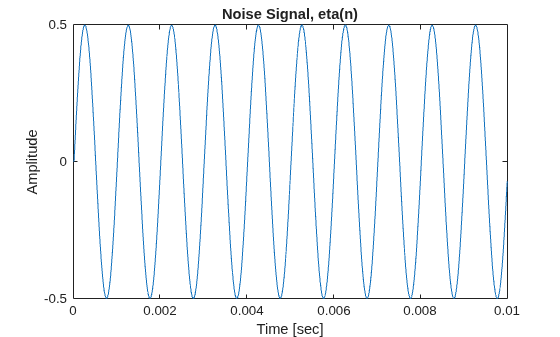
Adaptive Line Enhancer (ALE)
Apply adaptive filters to signal separation using a structure called an adaptive line enhancer (ALE). In adaptive line enhancement, a measured signal x(n) contains two signals, an unknown signal of interest v(n), and a nearly-periodic noise signal eta(n).
Adaptive Noise Cancellation Using RLS Adaptive Filtering
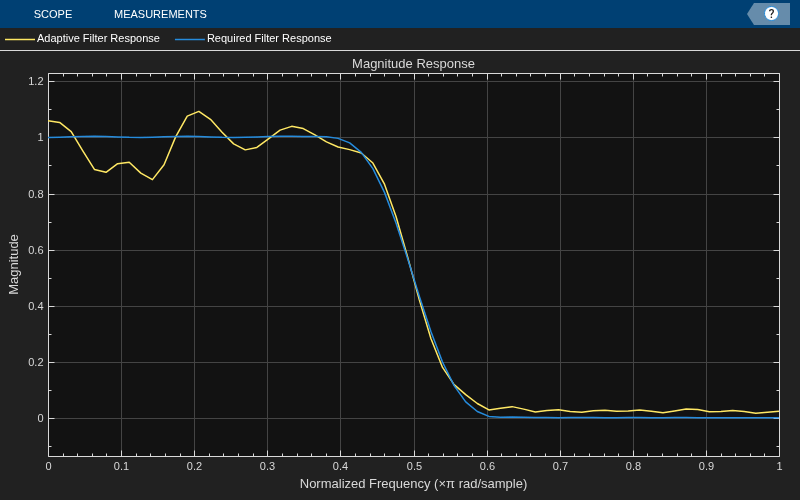
Use an RLS filter to extract useful information from a noisy signal. The information bearing signal is a sine wave that is corrupted by additive white Gaussian noise.
Acoustic Noise Cancellation (LMS)
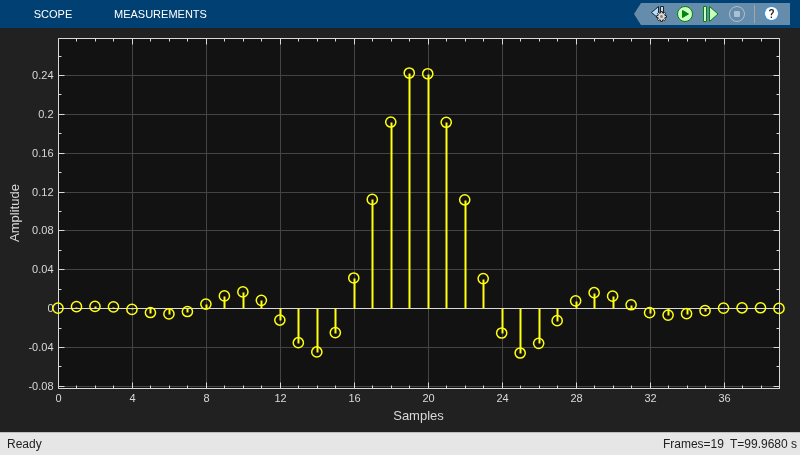
Use the least mean square (LMS) algorithm to subtract noise from an input signal. The example uses a preconfigured Simulink® model. The LMS Filter block in the dspanc model models an adaptive filter that uses the reference signal at its Input port and the desired signal at the Desired port to automatically match the filter response. The LMS Filter block subtracts the filtered noise from the original signal. As the filter converges, the resultant error signal contains only the original signal.
Active Noise Control with Simulink Real-Time
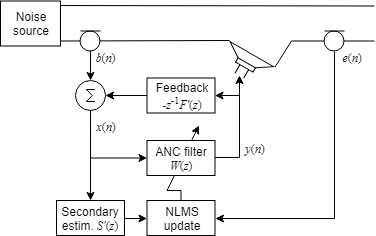
Design a real-time active noise control system using a Speedgoat® Simulink® Real-Time™ target.
Adaptive Filter Convergence
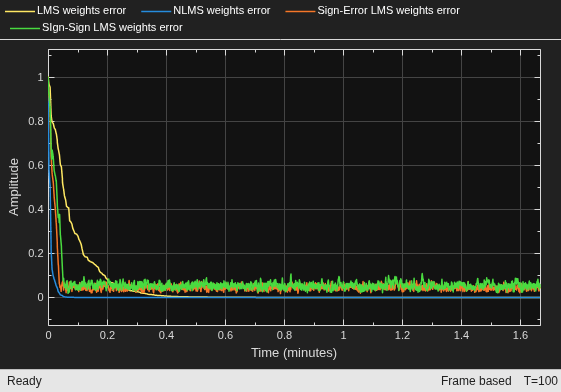
Compares the rate of convergence for adaptive filters using different LMS algorithms.
Noise Canceler (RLS)
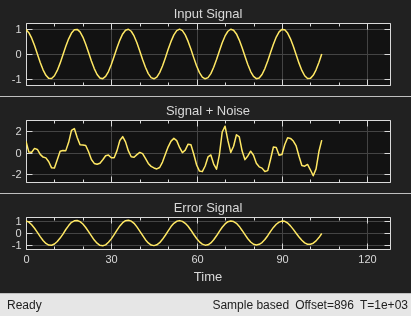
Subtract noise from an input signal using the Recursive Least Squares (RLS) algorithm. The RLS adaptive filter uses the reference signal on the Input port and the desired signal on the Desired port to automatically match the filter response in the Noise Filter block. As it converges to the correct filter, the filtered noise should be completely subtracted from the "Signal+Noise" signal, and the "Error Signal" should contain only the original signal.
Time-Delay Channel Estimation Through Adaptive Filtering
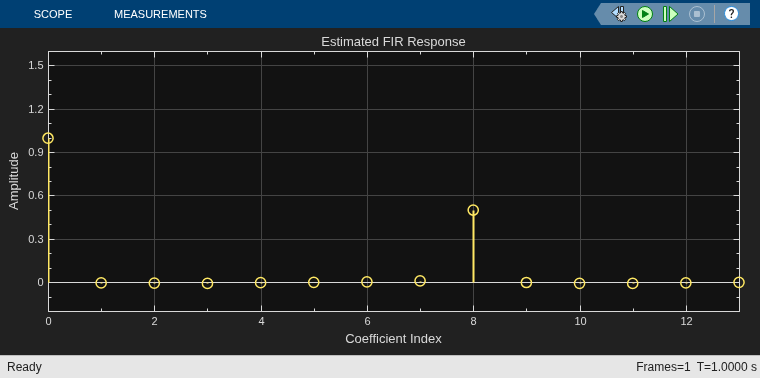
Adaptively estimate the time delay for a noisy input signal using the LMS adaptive FIR algorithm.

