Conversione dei dati della matrice MIMO in tabella orario per la stima del modello a tempo continuo
R2026bStimare una funzione del modello a tempo continuo convertendo prima i dati della matrice in una tabella orario.
Caricare i dati, che comprendono la matrice di input usteam, la matrice di output ysteam e il tempo di campionamento Ts.
load sdatasteam.mat usteam ysteam Ts
Combinare usteam e ysteam nella tabella orario singola ttsteam. Per creare una variabile per ciascun canale, è necessario specificare esplicitamente ogni colonna della matrice.
tts = timetable(usteam(:,1),usteam(:,2),ysteam(:,1),ysteam(:,2),...
    'rowtimes',seconds(Ts*(1:size(usteam,1))));
head(tts,4)
      Time       Var1       Var2        Var3        Var4
    ________    _______    _______    ________    _________

    0.05 sec    -1.5283     2.0584     0.57733     -0.12274
    0.1 sec      1.4412     -2.005     0.75804    -0.086114
    0.15 sec     1.4314     2.0584    -0.76577     -0.19845
    0.2 sec      1.4412    -1.9806     0.47721     -0.20577
Stimare un modello stato-spazio a tempo continuo.
nx = 3;
sysc = ssest(tts,nx,'InputName',["Var1" "Var2"],'OutputName',["Var3" "Var4"]);
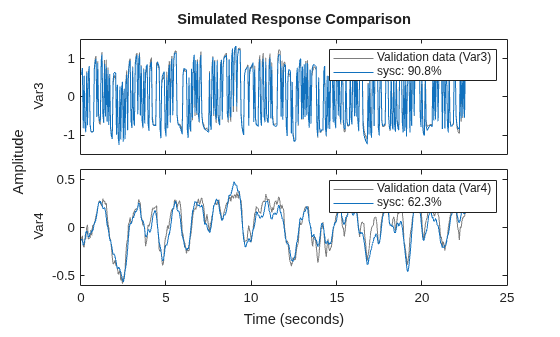
Paragonare il modello con i dati.
compare(tts,sysc)