Contenuto principale

evrnd

Extreme value random numbers

Description

r = evrnd(mu,sigma) generates a random number drawn from the type 1 extreme value distribution with the specified location parameter mu and scale parameter sigma.

r = evrnd(mu,sigma,sz1,...,szN) generates an array of random numbers, where sz1,...,szN indicates the size of each dimension.

example

r = evrnd(mu,sigma,sz) generates an array of random numbers, where the vector sz specifies size(r).

The type 1 extreme value distribution is also known as the Gumbel distribution. The software uses a version of the distribution that is suitable for modeling minima. You can use the mirror image of this distribution to model maxima by negating r. If x has a Weibull distribution, then X = log(x) has the type 1 extreme value distribution. See Extreme Value Distribution for more details.

Examples

collapse all

Generate 5000 random numbers from an extreme value distribution with the location parameter mu and scale parameter sigma.

rng(0,"twister") % For reproducibility
mu = 4;
sigma = 2;
r = evrnd(mu,sigma,[5000 1]);

Plot a histogram of the numbers.

histogram(r)
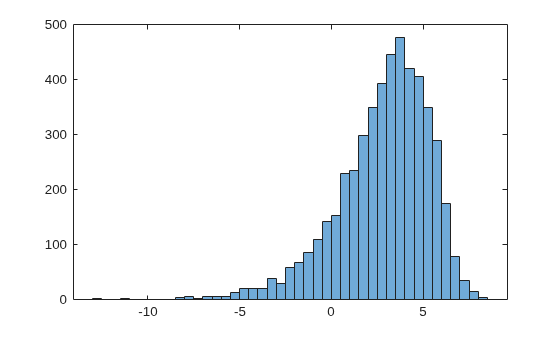
Figure contains an axes object. The axes object contains an object of type histogram.

Input Arguments

collapse all

Location parameter, specified as a numeric scalar or array.

To generate random numbers from multiple distributions, specify either mu or sigma (or both) using arrays. If either mu or sigma is an array, then the array sizes must be the same. In this case, evrnd expands the scalar input into a constant array of the same size as the array input.

Data Types: single | double

Scale parameter, specified as a positive scalar or an array of positive scalars.

To generate random numbers from multiple distributions, specify either mu or sigma (or both) using arrays. If either mu or sigma is an array, then the array sizes must be the same. In this case, evrnd expands the scalar input into a constant array of the same size as the array input.

Data Types: single | double

Size of each dimension, specified as separate arguments of integers. For example, specifying 5,3,2 generates a 5-by-3-by-2 array of random numbers from the probability distribution.

If either mu or sigma is an array, then the specified dimensions sz1,...,szN must match the common dimensions of mu and sigma after any necessary scalar expansion. The default values of sz1,...,szN are the common dimensions.

  • If you specify a single value sz1, then r is a square matrix of size sz1-by-sz1.

  • If the size of any dimension is 0 or negative, then r is an empty array.

  • Beyond the second dimension, evrnd ignores trailing dimensions with a size of 1. For example, specifying 3,1,1,1 produces a 3-by-1 vector of random numbers.

Data Types: single | double

Size of each dimension, specified as a row vector of integers. For example, specifying [5,3,2] generates a 5-by-3-by-2 array of random numbers from the probability distribution.

If either mu or sigma is an array, then the specified dimensions sz must match the common dimensions of mu and sigma after any necessary scalar expansion. The default values of sz are the common dimensions.

  • If you specify a single value sz1, then r is a square matrix of size sz1-by-sz1.

  • If the size of any dimension is 0 or negative, then r is an empty array.

  • Beyond the second dimension, evrnd ignores trailing dimensions with a size of 1. For example, specifying [3,1,1,1] produces a 3-by-1 vector of random numbers.

Data Types: single | double

Output Arguments

collapse all

Random numbers, returned as a scalar value or an array of scalar values with the dimensions specified by sz1,...,szN or sz. Each element in r is the random number generated from the distribution specified by the corresponding elements in mu and sigma.

Alternative Functionality

  • evrnd is a function specific to the type 1 extreme value distribution. Statistics and Machine Learning Toolbox™ also offers the generic function random, which supports various probability distributions. To use random, specify the probability distribution name and its parameters. Note that the distribution-specific function evrnd is faster than the generic function random.

  • To generate random numbers interactively, use randtool, a user interface for random number generation.

Extended Capabilities

expand all

Version History

Introduced before R2006a