Contenuto principale

PearsonDistribution

Pearson probability distribution object

Since R2025a

Description

A PearsonDistribution object consists of the parameters and model description for a Pearson probability distribution.

The Pearson distribution is a four-parameter distribution with an arbitrary mean, standard deviation, skewness, and kurtosis. This distribution is often used to model asymmetric data that is prone to outliers.

ParameterDescription
μMean
σStandard deviation
γSkewness γ, which is a measure of the asymmetry of the data around the sample mean. If the skewness is negative, the data spreads out more to the left of the mean than to the right. If the skewness is positive, the data spreads out more to the right. γ2 must be less than κ – 1.
κKurtosis κ, which is a measure of how prone a distribution is to outliers. The kurtosis of the normal distribution is 3. Distributions that are more prone to outliers than the normal distribution have a kurtosis value greater than 3, and distributions that are less prone have a kurtosis value less than 3. κ must be greater than γ2 + 1.

Creation

Create a PearsonDistribution object using the makedist function. When you use the function without specifying any name-value arguments, the PearsonDistribution object corresponds to the normal distribution.

Properties

expand all

You can view and modify properties using dot notation. For example, enter pd.Type to see the distribution type for the PearsonDistribution object pd. Enter pd.Mu = 3 to modify the distribution mean.

Distribution Parameters

Mean of the Pearson distribution, represented as a numeric scalar.

Data Types: single | double

Standard deviation of the Pearson distribution, represented as a positive numeric scalar.

Data Types: single | double

Skewness of the Pearson distribution, represented as a numeric scalar. The value of Gamma must be less than sqrt(Kappa – 1). For more information, see Skewness.

Data Types: single | double

Kurtosis of the Pearson distribution, represented as a numeric scalar. The value of Kappa must be greater than Gamma^2 + 1. For more information, see Kurtosis.

Data Types: single | double

Distribution Characteristics

This property is read-only.

Logical flag for a truncated distribution, represented as 0 or 1. If IsTruncated is 0, the distribution is not truncated. If IsTruncated is 1, the distribution is truncated.

Data Types: logical

This property is read-only.

Truncation interval for the probability distribution, represented as a vector of numeric scalars containing the lower and upper truncation boundaries.

Data Types: single | double

This property is read-only.

Number of parameters for the probability distribution, represented as a positive integer.

Data Types: double

This property is read-only.

Distribution parameter values, represented as a vector of numeric scalars.

Data Types: single | double

This property is read-only.

Type of Pearson distribution, specified as an integer from the interval [0 7].

This table describes the distribution corresponding to each Pearson distribution type.

Pearson Distribution TypeDescription
0Normal
14-parameter beta
2Symmetric 4-parameter beta
33-parameter gamma
4Distribution specific to the Pearson system
5Inverse 3-parameter gamma
6F location-scale
7Student's t location-scale

Data Types: single | double

This property is read-only.

Quadratic polynomial coefficients, represented as a 1-by-3 numeric vector. The ith element of coefs is the coefficient bi in the differential equation

p'(x)p(x)=a+(xμ)b0+b1(xμ)+b2(xμ)2,

which defines the Pearson distribution probability density function (pdf) p(x).

Data Types: single | double

This property is read-only.

Lower and upper support bounds of the Pearson distribution, represented as a 1-by-2 numeric vector.

For more information, see Support.

Data Types: single | double

Other Object Properties

This property is read-only.

Probability distribution name, specified as a character vector.

Data Types: char

This property is read-only.

Distribution parameter descriptions, represented as a cell array of character vectors. Each cell contains a short description of one distribution parameter.

Data Types: cell

This property is read-only.

Distribution parameter names, represented as a cell array of character vectors.

Data Types: cell

Object Functions

cdfCumulative distribution function
icdfInverse cumulative distribution function
iqrInterquartile range of probability distribution
meanMean of probability distribution
medianMedian of probability distribution
pdfProbability density function
plotPlot probability distribution object
randomRandom numbers
stdStandard deviation of probability distribution
truncateTruncate probability distribution object
varVariance of probability distribution

Examples

collapse all

Create a Pearson distribution object using the default parameter values, which correspond to the parameters of the standard normal distribution.

pd = makedist("Pearson")
pd = 
  PearsonDistribution

  Pearson distribution
       Mu = 0
    Sigma = 1
    Gamma = 0
    Kappa = 3

pd is a PearsonDistribution object with default values. You can use the object functions of pd to evaluate the distribution and generate random numbers. Display the supported object functions.

methods(pd)
Methods for class prob.PearsonDistribution:

cdf       gather    icdf      iqr       mean      median    pdf       plot      random    std       truncate  var       

For example, compute the interquartile range of the distribution by using the iqr function.

r = iqr(pd)
r = 
1.3490

Create a Pearson distribution object by specifying the parameter values.

pd = makedist("Pearson",mu=5,sigma=10,gamma=1,kappa=4)
pd = 
  PearsonDistribution

  Pearson distribution
       Mu =  5
    Sigma = 10
    Gamma =  1
    Kappa =  4

pd is a PearsonDistribution object with specified parameter values. View the distribution type.

pd.Type
ans = 
1

The type of the distribution is 1, which corresponds to a 4-parameter beta distribution.

Plot the pdf of the Pearson distribution.

plot(pd)
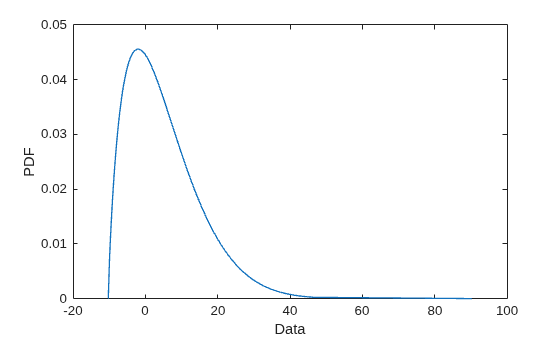
Figure contains an axes object. The axes object with xlabel Data, ylabel PDF contains an object of type line.

More About

expand all

Version History

Introduced in R2025a